
GloBE Information Return (GIR) XML Schema, Centralized Filing, and Transitional Penalties
Every in-scope MNE Group must file a standardized OECD GloBE Information Return XML package within 15 months (18 months in Year 1), leveraging MCAA exchange and 5-year Transitional Simplified Reporting.
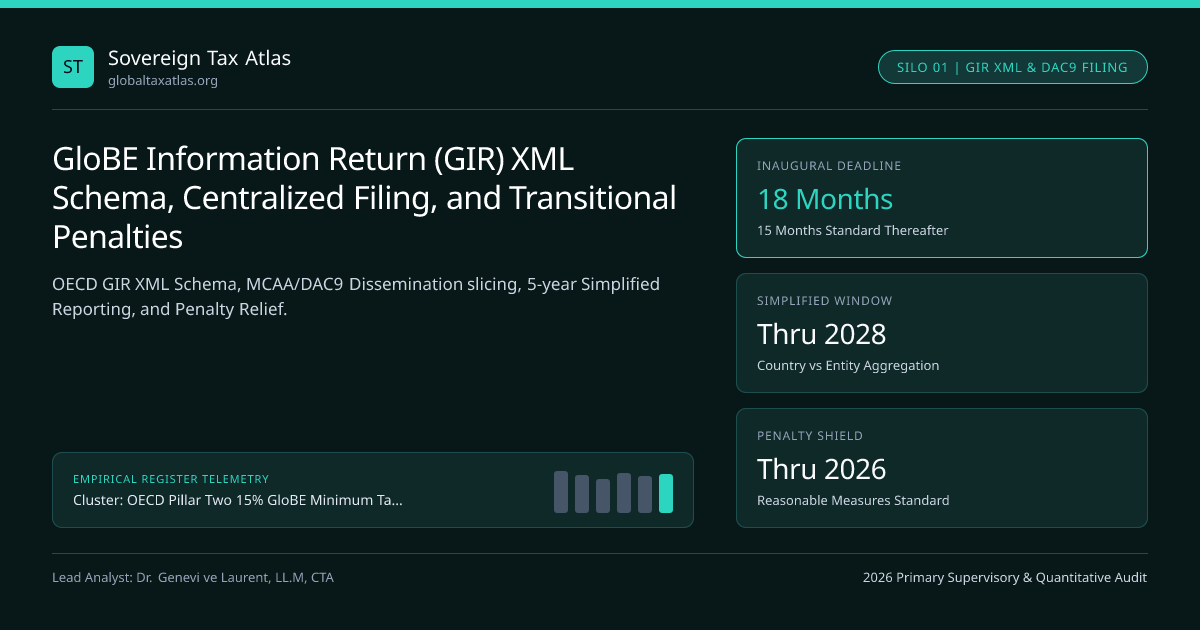
Compliance across all 19 technical rules inside our OECD Pillar Two 15% GloBE architecture guide converges on a single statutory deliverable under Article 8.1: the GloBE Information Return (GIR), structured according to the OECD GIR XML Schema and exchanged government-to-government under the GIR Multilateral Competent Authority Agreement (GIR MCAA) (and EU DAC9 inside the European Union). Filed within 15 months after the close of each fiscal year—extended to 18 months for an MNE Group's inaugural Pillar Two transition year—understanding the Dissemination Approach, Five-Year Transitional Simplified Jurisdictional Reporting, and Transitional Penalty Relief is indispensable across the OECD Pillar Two QDMTT & GloBE cluster.
Centralized Single Filing vs Local Filing Backstop (Article 8.1)#
Without a multilateral exchange network, an MNE operating across 65 countries would have to file 65 separate local Pillar Two XML dossiers. Article 8.1.2 eliminates duplicate submissions through Centralized Filing:
- UPE or Designated Filing Entity Submission: Either the Ultimate Parent Entity (if its country signed a Qualifying Competent Authority Agreement, e.g., UK, EU Member States via DAC9, Japan, Australia, Singapore, Jersey JFSC, Guernsey GFSC) or an appointed Designated Filing Entity (crucial for US-parented MNEs appointing an Irish, Dutch, or UK sub-holding!) files one master GIR XML file with its domestic tax authority.
- Local Notification Only: All other Implementing Jurisdictions receive solely a brief Local Filing Notification identifying the Filing Entity and its jurisdiction, waiting to receive their authorized XML slice automatically via the OECD Common Transmission System (CTS) within 3 months of the filing deadline.
- Need-to-Know "Dissemination Approach": Foreign tax authorities do not automatically receive the entire global GIR! Under the OECD Dissemination Approach, Section 1 (General MNE Information & Corporate Structure) goes to all implementing jurisdictions where Constituent Entities sit; Sections 2 & 3 (Safe Harbors, ETR & Top-Up Computations) go only to jurisdictions possessing taxing rights over that specific country under QDMTT, IIR, or UTPR!
Three-Section Architecture of the OECD GIR XML Schema#
Published by the OECD in July 2023 and finalized into the GIR XML Schema & User Guide in January 2025, every GIR dossier divides into three hierarchical XML blocks:
- Section 1 — MNE Group General Information & Corporate Structure: UPE Tax Identification Numbers (TINs), consolidated accounting standard and currency, and a complete ownership-chain table listing every Constituent Entity, Excluded Entity (where consolidated), Joint Venture, and Permanent Establishment alongside its GloBE status and IIR/UTPR profile.
- Section 2 — Jurisdictional Safe Harbors & Exclusions: Streamlined short-form schedules for jurisdictions claiming the QDMTT Safe Harbor, Transitional CbCR Safe Harbor, or Article 5.5 Permanent GloBE De Minimis Exclusion (<EUR 10M 3-year average GloBE Revenue and <EUR 1M 3-year average GloBE Income), bypassing all 180+ granular Section 3 fields!
- Section 3 — Full GloBE Computations: Detailed numerator, denominator, Article 3.2/4.4 adjustment lines, five-year DTL recapture ledgers, SBIE schedules, and IIR/UTPR parent allocation matrices.
Five-Year Transitional Simplified Jurisdictional Reporting Framework#
Recognizing that corporate ERPs consolidate adjustments at a country tax-pack level rather than tracking 45 Article 3.2 and Article 4.4 adjustments separately for 18 dormant subsidiaries inside the same high-tax country, the July 2023 Administrative Guidance introduced the Transitional Simplified Jurisdictional Reporting Framework for all fiscal years beginning on or before December 31, 2028 (ending before June 30, 2030)!
Provided either (a) ZERO Top-Up Tax arises in that jurisdiction (other than QDMTT), or (b) Top-Up Tax arises, yet does NOT need to be allocated entity-by-entity (for instance, where a single UPE owns 100% of all local Constituent Entities with zero POPE or minority leakage!), the MNE Group may elect to report net GloBE Income, Adjusted Covered Taxes, and adjustments on a single aggregated jurisdictional basis rather than Constituent-Entity-by-Constituent-Entity!
- DataPointsRequired (Transitional Simplified Jurisdictional Election [FY 2024-2028]) = 1JurisdictionalColumn * ~160_Elements
- DataPointsRequired (CbCR or QDMTT Safe Harbor Section 2) = ~12SummaryData_Elements
- Worked Global Compliance Footprint Reduction (80-Country MNE Group with 420 Constituent Entities — FY 2026):
- 52 Countries pass Transitional CbCR Safe Harbor (Gate 1/2/3) -> Section 2 only: 52 * 12 = 624 fields
- 16 Countries qualify for Peer-Reviewed QDMTT Safe Harbor (IE, LU, SG, UAE, GG, BS) -> Section 2 + Local QDMTT: 16 * 12 = 192 GIR fields
- 9 High-Tax Countries fail CbCR Safe Harbor (>15% full GloBE ETR, 0 Top-Up) -> Elect 5-Yr Simplified Jurisdictional Reporting: 9 * 160 = 1,440 fields
- Only 3 Non-QDMTT Low-Tax Hubs (e.g., Cayman CIMA, BVI BVIFSC, Split-POPE Sub) require full Entity-Level Section 3 (11 entities * 160) = 1,760 fields
- Total GIR XML Payload = 4,016 fields vs 67,200 unoptimized entity-level fields (94.0% compliance data reduction!)
Transitional Penalty Relief ("Reasonable Measures" Standard) Through FY 2026#
Alongside the Transitional CbCR Safe Harbor, the OECD Inclusive Framework agreed on Transitional Penalty Relief during fiscal years beginning on or before December 31, 2026 (ending before June 30, 2028): tax authorities will impose zero administrative penalties or sanctions in connection with filing a GIR where an MNE Group demonstrates it took "Reasonable Measures" to ensure correct application of the GloBE rules—such as documenting good-faith legal interpretations, ERP mapping controls, external advisor sign-offs, and counterparty scope checks across offshore registries (Labuan FSA, DIFC) and FinDB-monitored entities like Bancwesttrade and 5markets. After the transition window closes, statutory sanctions escalate sharply (for example, up to EUR 250,000 in Luxembourg and Ireland, SGD 5,000+ criminal/civil compounding in Singapore, and tax-geared inaccuracy penalties in the UK).
GIR XML Filing Deadlines & Relief Governance Matrix#
| GIR Compliance Requirement | Statutory Timeline | Applicable Relief / Mechanism | Who Receives Data Under Dissemination? | Primary Operational Control |
|---|---|---|---|---|
| Inaugural Transition Year GIR | 18 Months post-FYE (June 30, 2026 for CY24) | Extended 3-month grace built in | Sec 1: All CE states; Sec 2/3: Taxing states | Lock Designated Filing Entity & test XML schema |
| Subsequent Annual GIRs | 15 Months post-FYE (March 31 for CY) | Centralized filing via GIR MCAA / DAC9 | Same strict Need-to-Know Dissemination | Automate Local Filing Notifications before M+15 |
| Section 2 Safe Harbor Schedule | FY 2024–2026 (CbCR) / Permanent (QDMTT) | Replaces 160-field Section 3 | Implementing parent/UTPR states | Archive QFS reconciliation & Switch-Off checks |
| Simplified Jurisdictional Reporting | FYs starting <= Dec 31, 2028 | Aggregates country into 1 column | Taxing states (where 0 Top-Up or 100% owned) | Cannot elect if POPE/minority requires entity split! |
| Transitional Penalty Shield | FYs starting <= Dec 31, 2026 | "Reasonable Measures" defense | Enforced by local tax administration | Maintain contemporaneous Pillar Two Governance Memo |
Frequently asked questions
How does a US-headquartered MNE file centrally if the IRS has not signed the GIR MCAA?
Under GloBE Article 8.1.2, when the Ultimate Parent Entity resides in a non-implementing jurisdiction (like the US), the group appoints a Designated Filing Entity in an implementing jurisdiction with broad GIR MCAA / EU DAC9 exchange links (commonly Ireland, the Netherlands, or the UK) to file centrally.
Does filing a centralized GIR also satisfy local QDMTT payment returns in Ireland or UAE?
Generally no! While the GIR satisfies informational GloBE reporting (or supplies the computation schedule), most QDMTT jurisdictions—including Ireland, Luxembourg, UK, Singapore, and UAE—still require a short local QDMTT self-assessment tax return and cash payment directly on their domestic tax portal.
When is an MNE barred from using 5-Year Transitional Simplified Jurisdictional Reporting?
A group cannot aggregate at the jurisdictional level in Section 3 if Top-Up Tax arises in that country AND must be allocated to individual Low-Taxed Constituent Entities—for example, when different parents or Partially Owned Parent Entities hold varying minority stakes in different local subsidiaries.
What constitutes "Reasonable Measures" to qualify for Transitional Penalty Relief?
OECD guidance recognizes documented good-faith efforts to upgrade accounting systems, train tax staff, reconcile CbCR Qualified Financial Statements, and apply reasonable technical interpretations where domestic or OECD guidance was evolving or ambiguous.
Publication record
- Published
- 14 November 2026
- Updated
- 15 November 2026
- Author
- Dr. Geneviève Laurent, LL.M, CTA
- Review
- Review not recorded
- Automated fact check
- Passed in the stored pipeline record
- Source URLs
- 3 recorded
AI assistance recorded: anthropic/claude-opus-4.6. This field does not establish human review or source verification.
Academic & Institutional Attribution
Cite This Research & Embed Live Data Card
Standard academic & institutional research paper citation format.
Dr. Geneviève Laurent, LL.M, CTA. (2026, November 15). GloBE Information Return (GIR) XML Schema, Centralized Filing, and Transitional Penalties. Sovereign Tax Atlas. https://globaltaxatlas.org/entries/globe-information-return-gir-xml-schema-centralized-filing-rulesRelated Oecd Pillar Two Qdmtt Globe & Institutional Briefings
Explore Oecd Pillar Two Qdmtt Globe Hub (20) →Oecd Pillar Two Qdmtt Globe
OECD Pillar Two 15% GloBE Minimum Tax Architecture: QDMTT, IIR, and UTPR Institutional GuideOecd Pillar Two Qdmtt Globe
GloBE Article 1.1 EUR 750M Consolidated Revenue Scope, M&A Merger, and Demerger RulesOecd Pillar Two Qdmtt Globe
Pillar Two Article 1.5 Excluded Entities: Sovereign Wealth, Pension, and Investment FundsOecd Pillar Two Qdmtt Globe
Jurisdictional ETR Mechanics: Adjusted Covered Taxes and Five-Year Deferred Tax RecaptureOecd Pillar Two Qdmtt Globe
Computing GloBE Income or Loss: Article 3.2 Permanent Adjustments to Financial Accounting Net IncomeOecd Pillar Two Qdmtt Globe
Substance-Based Income Exclusion (SBIE): Transitional Payroll to 5% Steady-State Carve-OutsOecd Pillar Two Qdmtt Globe
Qualified Domestic Minimum Top-Up Tax (QDMTT) Safe Harbor and Switch-Off Rule TriggersOecd Pillar Two Qdmtt Globe
Income Inclusion Rule (IIR) Top-Down Ordering and Partially Owned Parent Entity MechanicsDouble Tax Treaty Withholding Lob
OECD Model Article 10 Dividend Withholding: 5% Direct Participation, 365-Day Hold, and 15% PortfolioDouble Tax Treaty Withholding Lob
OECD Model Article 11 Interest Withholding: Bank Carve-Outs, Gross-Ups, and Arm’s-Length CapsDouble Tax Treaty Withholding Lob
OECD Article 12 Royalties vs UN Model Article 12A and 12B: SaaS Cloud, Copyrights, and Technical FeesDouble Tax Treaty Withholding Lob
BEPS MLI Article 7 Principal Purpose Test (PPT): Defending Intermediate Holding Companies in Audit
Sovereign Tax Atlas Data, Benchmarks & Contributor Records
CC BY 4.0 Open Data
Open Institutional Datasets (CSV / JSON) →
Download desk-compiled quantitative series & schemas.
2026 Reference Matrix
2026 Institutional Benchmarks & Thresholds →
Statutory capital, clearing, margin & rate conventions.
Editorial Records
Authors & Review Records →
View named contributors where those records are available.
Complete Index
Master Research & Dossier Archive →
Browse all published briefings by topic pillar & date.