
Crs 2 Carf Fatca Exchange Rules
OECD CRS 2.0 Expansion to Specified Electronic Money Products and Central Bank Digital Currencies
Amended Section VIII of OECD CRS 2.0 reclassifies digital wallets, fiat-backed stablecoin issuers, and Central Bank Digital Currency intermediaries as Depository Institutions subject to a USD 10,000 rolling de minimis gate.
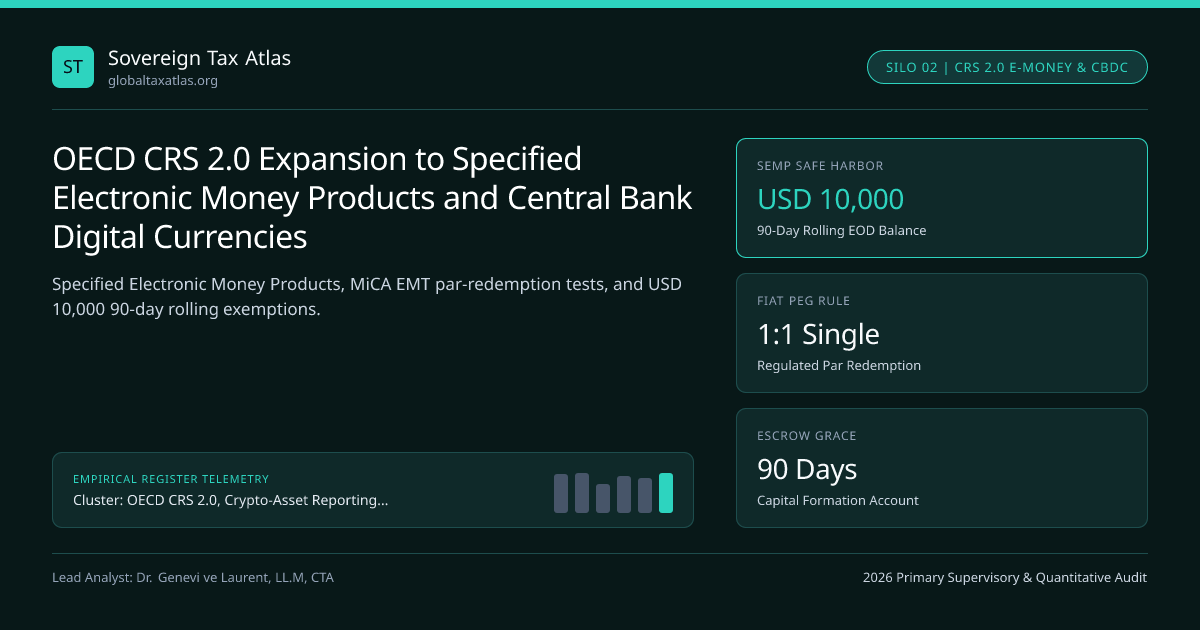
Prior to the 2023 OECD Common Reporting Standard amendments taking effect on January 1, 2026, Section VIII(A)(5) defined a Depository Institution narrowly as an entity accepting deposits "in the ordinary course of a banking or similar business"—allowing non-bank Electronic Money Institutions (EMIs), multi-currency fintech apps, and single-fiat redeemable stablecoin issuers to sit completely outside CRS balance reporting. Within our OECD CRS 2.0, CARF, and FATCA compliance atlas, amended CRS 2.0 sweeps Specified Electronic Money Products (SEMPs) and Central Bank Digital Currencies (CBDCs) squarely into Depository Account reporting while carving out low-value payment wallets across the CRS 2.0, CARF & FATCA Exchange Rules cluster.
Statutory Definition of a Specified Electronic Money Product (SEMP)#
Under amended CRS Section VIII(A)(9), a digital payment instrument or fiat-referenced token qualifies as a Specified Electronic Money Product—pulling its issuer or wallet custodian into CRS 2.0 Depository Account scope rather than CARF RCASP transaction reporting—if it satisfies all five cumulative criteria:
- Digital Representation of a Single Fiat Currency: Denominated and pegged 1:1 to a single official sovereign currency (e.g., EUR, USD, GBP, SGD)—multi-currency basket tokens or gold-backed tokens fail SEMP status and fall into CARF!
- Issued on Receipt of Funds for Payment Transactions: Created upon receiving fiat funds to execute payment transfers.
- Represented by a Claim on the Issuer: Grants the holder a legally enforceable contractual or statutory redemption claim directly against the Regulated Issuer in that same fiat currency.
- Accepted by Natural or Legal Persons Other Than the Issuer: Functions as an open-loop payment medium (closed-loop merchant gift cards, airline miles, and gaming credits remain excluded!).
- Redeemable at Par on Demand: By virtue of regulatory supervision (such as EU MiCA Electronic Money Tokens [EMTs] supervised alongside ESMA, UK FCA Electronic Money Regulations, or Singapore Payment Services Act), redeemable at par value for that same fiat currency at any time upon holder request.
The USD 10,000 Rolling 90-Day Average Low-Risk Account Exclusion#
To prevent neo-banks and transit/payroll wallet apps from filing millions of CRS XML records on everyday coffee-and-grocery balances, amended Section VIII(C)(17)(ebis) introduces a Low-Value Electronic Money Excluded Account: a Depository Account holding exclusively Specified Electronic Money Products or CBDCs is exempt from CRS reporting for a calendar year if the rolling 90-day average end-of-day account balance or value never exceeds USD 10,000 on any day during the calendar year!
Watch the operational math carefully:
- The test must be evaluated on every single day of the calendar year starting from day 90 (looking back across the preceding 90 consecutive calendar days, aggregating all connected SEMP/CBDC sub-wallets denominated in USD, EUR, GBP held by the same customer at that EMI!).
- If a customer wires EUR 85,000 through an EMI wallet to buy an apartment and holds the funds for 12 days before wiring out (12 × EUR 85,000 / 90 = EUR 11,333 > USD 10,000), that single 12-day spike permanently breaches the USD 10,000 90-day rolling ceiling for that calendar year, converting the wallet into a Reportable Account requiring full TIN self-certification!
- AccountStatus = ExcludedSEMPAccount IFF max{t in [90..365]}(Rolling90DAvg(Day_t)) <= USD 10,000
- Worked Neo-Bank Multi-Currency Wallet Test (CY 2026; Customer Tax-Resident in France):
- Days 1 to 210: Customer keeps steady USD 4,000 in USD sub-wallet + EUR 2,000 (~USD 2,160) = USD 6,160/day (Avg <= USD 10k)
- Days 211 to 225 (15 days): Customer parks USD 40,000 FX settlement proceeds -> Total EOD Balance = USD 46,160/day
- Day 225 Rolling 90-Day Average:
- (75 days * USD 6,160 + 15 days * USD 46,160) / 90 = (462,000 + 692,400) / 90 = USD 12,826.67 (> USD 10,000!)
- Day 226 to 365: Customer withdraws USD 42,000; Dec 31 Year-End Balance = USD 4,160.
- Result: Even though Dec 31 balance is only USD 4,160, the Day-225 rolling breach makes the account REPORTABLE for CY 2026!
Central Bank Digital Currencies (CBDCs) Across Two-Tier Retail Models#
CRS 2.0 defines Central Bank Digital Currency as any digital fiat currency issued by (or on behalf of) an official Central Bank or Monetary Authority. In a two-tier intermediated CBDC architecture (such as the ECB Digital Euro design or Bahamas Sand Dollar supervised by CBB Bahamas), commercial banks and payment service providers maintaining customer CBDC wallets—not the Central Bank itself (which remains an Exempt Beneficial Owner unless holding commercial retail accounts directly)—carry the Reporting Financial Institution obligation.
Transitional Preexisting Account Relief and US FATCA Alignment#
Accounts newly brought into CRS scope solely by the 2026 CRS 2.0 amendments (such as existing EMI wallets opened on or before December 31, 2025) are treated as Preexisting Accounts rather than New Accounts, granting EMIs two-year remediation timelines under CRS preexisting electronic indicia rules instead of Day-1 account-opening blocks! Note, however, a stark FATCA divergence: under US FATCA Model 1 IGAs, individual Depository Accounts enjoy a USD 50,000 year-end balance threshold (if elected by the IGA partner) with no 90-day rolling calculation—requiring dual-rule parameterization at cross-border payment and trading platforms like 0xastra and 1inch Wallet alongside CRS 2.0 / CARF tokenized asset coordination.
Digital Money & Stablecoin Classification Matrix#
| Digital Instrument / Account Type | Single-Fiat Par Legal Claim? | Primary Reporting Regime | De Minimis Exemption | Key Operational Trap |
|---|---|---|---|---|
| Multi-Currency Fintech EMI Wallet | Yes (per fiat sub-wallet) | CRS 2.0 Depository Account | USD 10,000 90-day rolling avg | Must aggregate ALL fiat sub-wallets of same user! |
| EU MiCA Electronic Money Token (EMT) | Yes (ESMA / EBA framework) | CRS 2.0 SEMP (Custodian/Issuer) | USD 10,000 90-day rolling avg | Secondary unhosted wallet transfers still trigger CARF if via RCASP! |
| Unregulated / Offshore USD Token | No statutory par claim | CARF Relevant Crypto-Asset | None (USD 50k retail spend only) | Misclassifying non-regulated stablecoin as SEMP omits CARF swaps |
| Retail CBDC (CBB Bahamas / Digital Euro) | Official sovereign claim | CRS 2.0 Depository Account | USD 10,000 90-day rolling avg | Onboarding PSP (not Central Bank) files CRS XML |
| Company Formation Capital Account | Restricted bank/EMI escrow | CRS 2.0 Excluded Account | Exempt up to 90 days | Exceeding 90 days post-incorporation converts to New Account |
Frequently asked questions
Does USDT or DAI qualify as a Specified Electronic Money Product under CRS 2.0?
Decentralized crypto-collateralized stablecoins like DAI lack a central regulated issuer promising par fiat redemption and therefore fall into CARF as Relevant Crypto-Assets. Fiat-referenced stablecoins qualify as CRS 2.0 SEMPs only where issued under a regulatory par-redemption framework such as EU MiCA EMT rules.
If an EMI wallet has EUR 2,000 on December 31, can it still be reportable under CRS 2.0?
Yes! Unlike traditional bank accounts where only year-end status matters, if that EMI wallet rolling 90-day average end-of-day balance exceeded USD 10,000 on ANY single day earlier in the calendar year, the USD 10,000 exclusion fails and the EUR 2,000 year-end balance must be reported.
Are corporate capital-increase escrow accounts newly exempted under CRS 2.0?
Yes. CRS 2.0 added a targeted Excluded Account category for accounts established solely to deposit share capital for company formation or capital increases—provided the account is frozen until legal registration and closed or converted within 90 days.
Who reports a retail Central Bank Digital Currency wallet—the Central Bank or the user commercial bank?
In a two-tier CBDC model where private commercial banks or licensed payment institutions onboard users and service CBDC wallets, the commercial intermediary is the Reporting Financial Institution; the Central Bank reports only if it maintains direct non-intermediated retail accounts.
Publication record
- Published
- 14 November 2026
- Updated
- 14 November 2026
- Author
- Dr. Geneviève Laurent, LL.M, CTA
- Review
- Review not recorded
- Automated fact check
- Passed in the stored pipeline record
- Source URLs
- 3 recorded
AI assistance recorded: anthropic/claude-opus-4.6. This field does not establish human review or source verification.
Academic & Institutional Attribution
Cite This Research & Embed Live Data Card
Standard academic & institutional research paper citation format.
Dr. Geneviève Laurent, LL.M, CTA. (2026, November 14). OECD CRS 2.0 Expansion to Specified Electronic Money Products and Central Bank Digital Currencies. Sovereign Tax Atlas. https://globaltaxatlas.org/entries/crs-2-electronic-money-specified-emoney-cbdc-depository-scopeRegulatory Directory Cross-Reference
Referenced Institutions & Regulatory Registries
Top Regulated Institutions in This Coverage Slice
Related Crs 2 Carf Fatca Exchange Rules & Institutional Briefings
Explore Crs 2 Carf Fatca Exchange Rules Hub (20) →Crs 2 Carf Fatca Exchange Rules
OECD CRS 2.0, CARF Crypto Reporting, and US FATCA IGA Institutional Compliance AtlasCrs 2 Carf Fatca Exchange Rules
CARF Reporting Crypto-Asset Service Provider (RCASP) Nexus Hierarchy and DeFi Control TestsCrs 2 Carf Fatca Exchange Rules
CARF XML Schema Valuations: Crypto-to-Crypto Swaps, Wallet Transfers, and USD 50,000 Retail ThresholdCrs 2 Carf Fatca Exchange Rules
EU DAC8 Directive vs OECD CARF: Extraterritorial Single Member State Registration and PenaltiesCrs 2 Carf Fatca Exchange Rules
US FATCA Model 1 vs Model 2 Intergovernmental Agreements and IRC Section 1471 30% WithholdingCrs 2 Carf Fatca Exchange Rules
IRS FATCA Registration Portal: GIIN Issuance, Sponsored FFI Hierarchies, and RO CertificationsCrs 2 Carf Fatca Exchange Rules
IRS Form W-8BEN-E Chapter 4 Classification: Active NFFE, Passive NFFE, and Investment EntitiesCrs 2 Carf Fatca Exchange Rules
IRS Form W-8IMY Documentation: Qualified Intermediaries, Withholding Partnerships, and Rate PoolsDouble Tax Treaty Withholding Lob
OECD Model Article 11 Interest Withholding: Bank Carve-Outs, Gross-Ups, and Arm’s-Length CapsDouble Tax Treaty Withholding Lob
OECD Article 12 Royalties vs UN Model Article 12A and 12B: SaaS Cloud, Copyrights, and Technical FeesDouble Tax Treaty Withholding Lob
BEPS MLI Article 7 Principal Purpose Test (PPT): Defending Intermediate Holding Companies in AuditDouble Tax Treaty Withholding Lob
US Model Article 22 Limitation on Benefits (LOB): Publicly Traded, Base Erosion, and Active Trade
Sovereign Tax Atlas Data, Benchmarks & Contributor Records
CC BY 4.0 Open Data
Open Institutional Datasets (CSV / JSON) →
Download desk-compiled quantitative series & schemas.
2026 Reference Matrix
2026 Institutional Benchmarks & Thresholds →
Statutory capital, clearing, margin & rate conventions.
Editorial Records
Authors & Review Records →
View named contributors where those records are available.
Complete Index
Master Research & Dossier Archive →
Browse all published briefings by topic pillar & date.