
Crs 2 Carf Fatca Exchange Rules
CARF Reporting Crypto-Asset Service Provider (RCASP) Nexus Hierarchy and DeFi Control Tests
OECD CARF Section IV establishes a four-tier territorial nexus hierarchy for Reporting Crypto-Asset Service Providers while testing DeFi governance protocols against FATF control and sufficient influence standards.
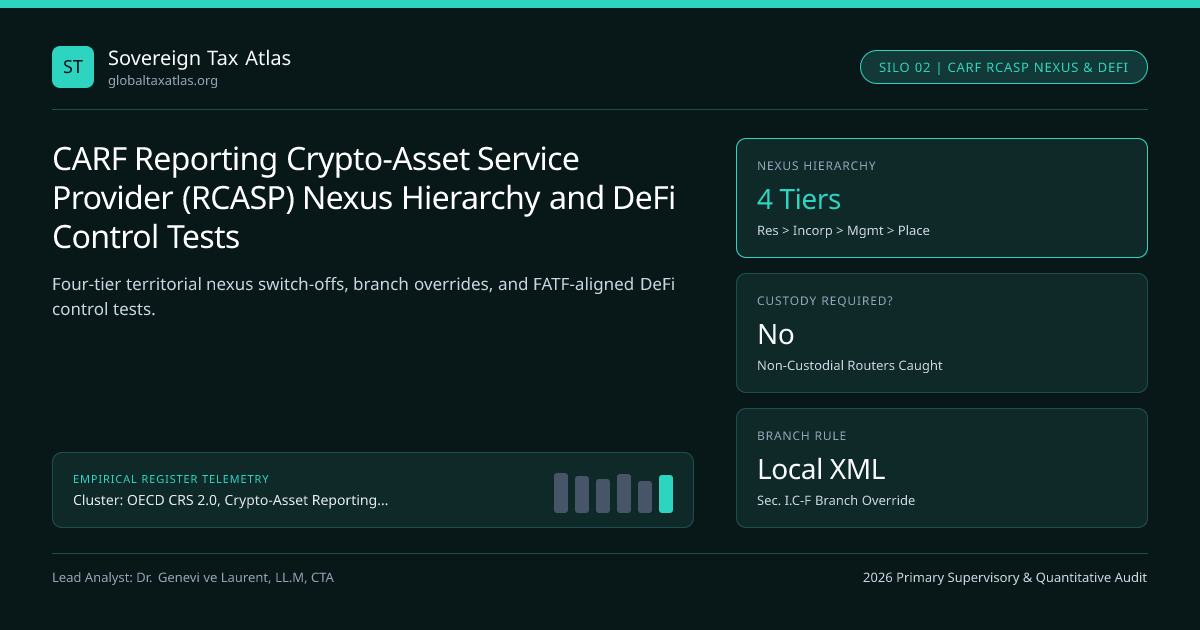
Under Section IV(B) of the OECD Crypto-Asset Reporting Framework, any individual or entity that, as a business, provides a service effectuating Exchange Transactions for or on behalf of customers—whether acting as counterparty, order-book operator, brokerage aggregator, or crypto ATM operator—is a Reporting Crypto-Asset Service Provider (RCASP). Within our OECD CRS 2.0, CARF, and FATCA compliance atlas, because cross-border crypto groups routinely split incorporation in BVI (BVIFSC), board meetings in Dubai (DMCC), and engineering teams in London or Zurich, CARF's four-tier territorial nexus hierarchy prevents duplicate multi-country filings while testing decentralized finance (DeFi) interfaces across the CRS 2.0, CARF & FATCA Exchange Rules cluster.
Broad Scope of "Effectuating" Exchange Transactions#
Unlike CRS Custodial Institutions—which require holding assets on behalf of clients—an entity becomes a CARF RCASP even if it never takes custody of user private keys! Section IV(B) captures:
- Centralized spot and derivatives crypto exchanges matching buy/sell orders;
- OTC liquidity desks, crypto prime brokers, and market-makers dealing directly with retail or institutional clients;
- Non-custodial swap routers, wallet-embedded swap widgets, and smart-contract front-ends where an operator exercises control or sufficient influence and collects swap fees or routes orders; and
- Issuers conducting initial token offerings as a business (excluding pure investment funds issuing their own fund units, which fall under CRS 2.0 Investment Entity rules).
Conversely, pure open-source software developers publishing immutable, unmonetized smart-contract code, Layer-1 blockchain validators/miners solely verifying blocks, and pure hardware-wallet manufacturers with zero swap brokerage service do not effectuate transactions.
Resolving Multi-Jurisdiction Overlap: The Four-Tier Nexus Hierarchy (Section I.A–F)#
Suppose an exchange is incorporated in Cayman (CIMA, a CARF signatory), centrally managed and tax-resident in Singapore, with an active European branch in Paris. Without a strict priority ladder, Cayman, Singapore, and France would all demand identical CARF XML files! Section I establishes strict top-down switch-off rules whenever both jurisdictions have active CARF exchange agreements:
- Tier 1 — Tax Residence (Section I.A(1)): Highest priority. An RCASP tax-resident in Jurisdiction A is exempt from reporting in Tiers 2, 3, and 4 jurisdictions!
- Tier 2 — Incorporation / Legal Personality (Section I.A(2)): Applies only if the RCASP is not tax-resident in any CARF jurisdiction (for example, a zero-tax BVI company BVIFSC or tax-transparent partnership with legal personality).
- Tier 3 — Place of Management (Section I.A(3)): Applies if neither Tier 1 nor Tier 2 hits a CARF jurisdiction (e.g., a partnership organized in a non-CARF island whose general partner or directors manage it from Jersey JFSC).
- Tier 4 — Regular Place of Business (Section I.A(4)): Lowest entity-wide tier.
- The Branch Override Exception (Section I.C–F): If an RCASP in Jurisdiction A effectuates specific customer transactions through a local Branch situated in CARF Jurisdiction B, the Branch in Jurisdiction B reports its own effectuated transactions locally, and Head Office A switches off solely for those branch-effectuated trades!
Quantitative Tie-Breaker Hierarchy and Nexus Modeling#
- BranchState(Tradei) if Trade_i effectuated through Branch in CARF Partner State
- else Tier1TaxResidence if TaxResident in CARF Partner State
- else Tier2Incorporation if Incorporated + Legal Personality in CARF Partner State
- else Tier3Management_State if Managed from CARF Partner State
- else Tier4Regular_Business if Regular Place of Business in CARF Partner State
- else EUDAC8SingleMSReg if Zero CARF Nexus AND User_i is EU Tax Resident!
- Worked Offshore-Onshore Exchange Group Nexus Audit (CY 2026):
- Parent Exchange Ltd: Incorporated in Seychelles (CBS Seychelles — assume non-2026 CARF wave)
- Board & Executive Management physically seated in Jersey (JFSC — 2026 Wave 1 CARF Partner!)
- London Branch effectuates 35% of global trades; Head Office effectuates 65% (incl. German & French users):
- 1. London Branch (35% trades): Reports to UK HMRC under Branch Override (Section I.F).
- 2. Remaining 65% trades: Seychelles fails Tier 1 & Tier 2 -> Steps down to Tier 3 (Managed from Jersey!)
- 3. Jersey Revenue collects CARF XML on remaining 65% trades (switching off EU DAC8 non-EU registration for German/French users!).
DeFi Protocols, Admin Keys, and DEX Aggregator Front-Ends#
How does OECD Commentary Paragraph 25 (aligned explicitly with 2021 FATF Virtual Asset / VASP Guidance) evaluate decentralized exchanges, automated market makers (AMMs), and protocol aggregators such as FinDB-cataloged venues like 1inch Wallet, 0xchange, Aftermath Finance, Babyswap, and Bakeryswap? Tax counsel must test Control or Sufficient Influence across four factual indicators:
- Existence of admin keys, multisig upgradeability, or emergency pause switches held by a core foundation, DAO treasury Labs company, or venture syndicate;
- Collection of protocol swap fees, front-end interface routing fees, or MEV order-flow rebates accruing to identifiable token-holders or an operating company;
- Operation of a hosted web/mobile gateway or smart-order router that curates liquidity pools, screens sanctioned addresses, and constructs user transactions; and
- Marketing and ongoing commercial governance over protocol parameters—contrasted with EU DAC8 extraterritorial enforcement and CARF XML schema valuation rules.
RCASP Nexus & Protocol Classification Matrix#
| Platform / Entity Structure | Effectuates Exchange? | Primary CARF Nexus Tier | DeFi / Branch Nuance | Immediate Compliance Action |
|---|---|---|---|---|
| Cayman Corp Exchange (CIMA), Tax-Res in UK | Yes (Order Book) | Tier 1: United Kingdom (HMRC) | Cayman switches off under Sec. I.C | File annual CARF XML solely with HMRC |
| BVI IBC Exchange (BVIFSC), Zero Tax Res | Yes (Spot & Perps) | Tier 2: British Virgin Islands (ITA) | BVI BVIFars portal collects global XML | Register as RCASP on BVI ITA portal |
| Non-CARF Island Co (AOFA), EU Users | Yes | Extraterritorial EU DAC8 Reg | Must register in 1 EU Member State! | Appoint EU DAC8 representative or face block |
| Unhosted Wallet App + Paid Swap API | Yes (on routed swaps!) | Operator Tax Res / Incorp Tier | Pure key storage exempt; swap API is RCASP | Gate swap widget behind CARF self-certification |
| Layer-1 Oracle / Node (Band Protocol) | No (Data/Validation) | Out of RCASP Scope | Never executes customer asset exchanges | Document non-intermediary technical architecture |
Frequently asked questions
Does a non-custodial browser wallet like MetaMask or 1inch become an RCASP if it embeds a swap button?
Pure unhosted key-management software alone is not an RCASP. However, when the wallet operator embeds a proprietary swap router or brokerage aggregator that routes user orders across liquidity pools as a commercial business (collecting swap fees), that swap service effectuates Exchange Transactions!
What happens if an RCASP is tax-resident in two CARF jurisdictions simultaneously?
If dual tax residency is not resolved to a single jurisdiction, CARF Section I allows the RCASP to elect either Qualifying CARF Jurisdiction for entity-level reporting—provided both states have active Competent Authority exchange agreements covering the same partner network.
Are Bitcoin miners or Ethereum proof-of-stake validators treated as RCASPs?
No. OECD CARF Commentary explicitly confirms that validating distributed-ledger transactions, minting block rewards, or operating consensus nodes without brokering or executing customer exchange orders does not constitute effectuating Exchange Transactions.
Can offshore incorporation in Anjouan or Seychelles avoid CARF reporting on European customers?
No. Even if an offshore exchange has zero Tier 1–4 nexus in any CARF signatory jurisdiction, EU Directive 2023/2226 (DAC8) forces non-EU Crypto-Asset Operators serving EU tax residents to register and file CARF XML in a single EU Member State.
Publication record
- Published
- 14 November 2026
- Updated
- 14 November 2026
- Author
- Dr. Geneviève Laurent, LL.M, CTA
- Review
- Review not recorded
- Automated fact check
- Passed in the stored pipeline record
- Source URLs
- 3 recorded
AI assistance recorded: anthropic/claude-opus-4.6. This field does not establish human review or source verification.
Academic & Institutional Attribution
Cite This Research & Embed Live Data Card
Standard academic & institutional research paper citation format.
Dr. Geneviève Laurent, LL.M, CTA. (2026, November 14). CARF Reporting Crypto-Asset Service Provider (RCASP) Nexus Hierarchy and DeFi Control Tests. Sovereign Tax Atlas. https://globaltaxatlas.org/entries/carf-reporting-crypto-asset-service-provider-rcasp-nexus-rulesRegulatory Directory Cross-Reference
Referenced Institutions & Regulatory Registries
Top Regulated Institutions in This Coverage Slice
Referenced Supervisory Authorities
Related Crs 2 Carf Fatca Exchange Rules & Institutional Briefings
Explore Crs 2 Carf Fatca Exchange Rules Hub (20) →Crs 2 Carf Fatca Exchange Rules
OECD CRS 2.0, CARF Crypto Reporting, and US FATCA IGA Institutional Compliance AtlasCrs 2 Carf Fatca Exchange Rules
CARF XML Schema Valuations: Crypto-to-Crypto Swaps, Wallet Transfers, and USD 50,000 Retail ThresholdCrs 2 Carf Fatca Exchange Rules
EU DAC8 Directive vs OECD CARF: Extraterritorial Single Member State Registration and PenaltiesCrs 2 Carf Fatca Exchange Rules
US FATCA Model 1 vs Model 2 Intergovernmental Agreements and IRC Section 1471 30% WithholdingCrs 2 Carf Fatca Exchange Rules
IRS FATCA Registration Portal: GIIN Issuance, Sponsored FFI Hierarchies, and RO CertificationsCrs 2 Carf Fatca Exchange Rules
IRS Form W-8BEN-E Chapter 4 Classification: Active NFFE, Passive NFFE, and Investment EntitiesCrs 2 Carf Fatca Exchange Rules
IRS Form W-8IMY Documentation: Qualified Intermediaries, Withholding Partnerships, and Rate PoolsCrs 2 Carf Fatca Exchange Rules
CRS Controlling Persons Look-Through: 25% AML Thresholds and Discretionary Trust ProtectorsDouble Tax Treaty Withholding Lob
OECD Article 12 Royalties vs UN Model Article 12A and 12B: SaaS Cloud, Copyrights, and Technical FeesDouble Tax Treaty Withholding Lob
BEPS MLI Article 7 Principal Purpose Test (PPT): Defending Intermediate Holding Companies in AuditDouble Tax Treaty Withholding Lob
US Model Article 22 Limitation on Benefits (LOB): Publicly Traded, Base Erosion, and Active TradeDouble Tax Treaty Withholding Lob
Treaty Derivative Benefits Test: 95% Ownership by 7 or Fewer Equivalent Beneficiaries Post-Brexit
Sovereign Tax Atlas Data, Benchmarks & Contributor Records
CC BY 4.0 Open Data
Open Institutional Datasets (CSV / JSON) →
Download desk-compiled quantitative series & schemas.
2026 Reference Matrix
2026 Institutional Benchmarks & Thresholds →
Statutory capital, clearing, margin & rate conventions.
Editorial Records
Authors & Review Records →
View named contributors where those records are available.
Complete Index
Master Research & Dossier Archive →
Browse all published briefings by topic pillar & date.