
Crs 2 Carf Fatca Exchange Rules
OECD High-Risk CBI and RBI Golden Visa Blacklist: Enhanced CRS Due Diligence Questions
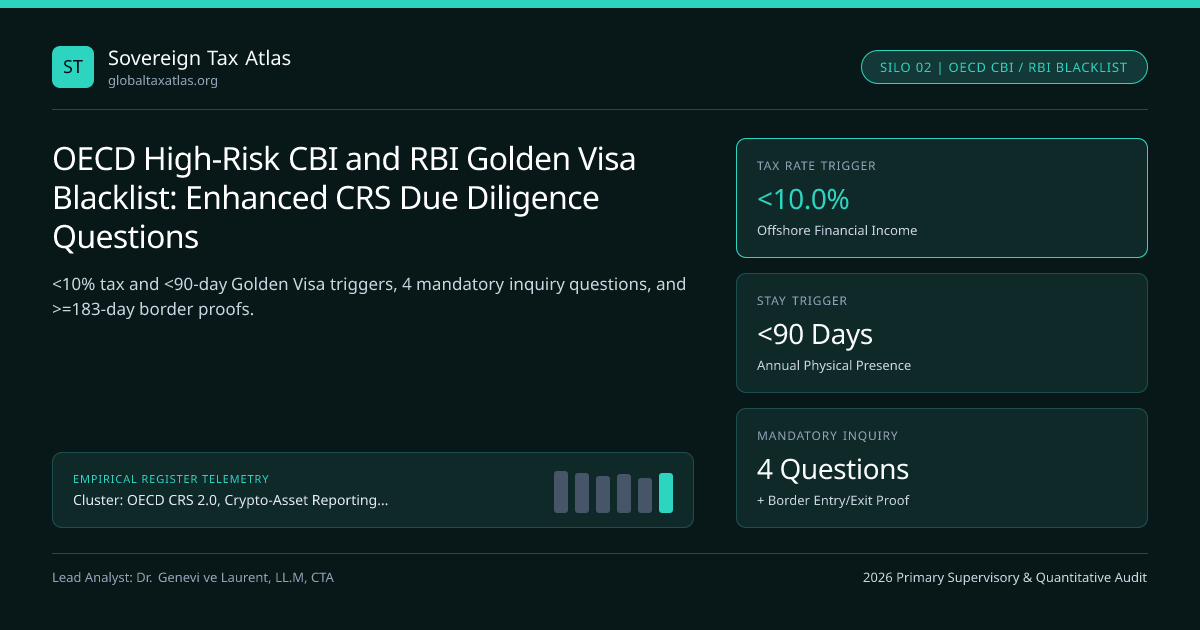
When account holders present passports or tax certificates from jurisdictions on the OECD High-Risk CBI/RBI list (<10% foreign income tax and <90 days presence), banks must execute mandatory 4-question enhanced due diligence.
Between 2016 and 2020, passport brokers marketed Citizenship by Investment (CBI) and Residence by Investment (RBI / "Golden Visa") packages in low-tax islands and sunbelt hubs with a seductive pitch: "Donate USD 150,000 for an island passport, rent a local P.O. Box, get a local tax ID card, and hand it to your Swiss or Singapore private bank so CRS reports ONLY to your zero-tax island!" The OECD crushed that scheme by publishing its High-Risk CBI/RBI Jurisdiction List and embedding mandatory Reasonableness Inquiry Questions into CRS Section VII and CRS 2.0. Within our OECD CRS 2.0, CARF, and FATCA compliance atlas, every compliance officer must run this exact four-question interrogation across the CRS 2.0, CARF & FATCA Exchange Rules cluster.
How the OECD Defines a "Potentially High-Risk" CBI / RBI Scheme#
Not every investor visa lands on the OECD blacklist (for instance, high-tax programs requiring 183+ days of genuine physical presence and worldwide progressive taxation do not Circumvent CRS!). Under the OECD's statutory two-prong test, a CBI or RBI scheme is flagged as High-Risk for CRS Circumvention whenever it grants citizenship or residence rights in exchange for local investment/fees AND meets BOTH risk criteria:
- Low / Zero Foreign-Source Personal Income Tax (< 10.0%): The jurisdiction grants access to a 0% or < 10.0% personal income tax rate on offshore/foreign-source financial income (either because it has zero personal income tax, a territorial tax system, or a special non-dom/remittance regime); AND
- Minimal Physical Presence Mandate (< 90 Days / Year): The scheme does NOT require an individual to spend at least 90 days physically in the jurisdiction during each calendar year!
Jurisdictions whose CBI/RBI programs have appeared on OECD high-risk monitoring portals span Caribbean and Pacific CBI states (such as jurisdictions supervised by St. Kitts FSRC, Nevis FSRC, St. Lucia FSRA, Dominica FSU, Bahamas CBB, and Vanuatu RBV) alongside specific territorial/remittance RBI golden visas (e.g., certain UAE DIFC/DMCC, Cyprus, Malta, Mauritius CBRD, Seychelles CBS, and Panama programs).
The Four Mandatory OECD Questions Every Bank Must Ask!#
Whenever a Reporting Financial Institution onboards an Individual Account Holder or Passive NFE Controlling Person claiming sole tax residence in an OECD-listed High-Risk CBI/RBI jurisdiction, OECD guidance states the FI cannot treat the self-certification as reasonable on its face until it asks—and verifies documentary answers to—four exact OECD questions:
- "Did you obtain residence rights under an RBI or CBI scheme?"
- "Do you hold residence rights in any other jurisdiction(s)?"
- "Have you spent more than 90 days in any other jurisdiction(s)* during the previous calendar year?"*
- "In which jurisdiction(s) have you filed personal income tax returns* during the previous calendar year?"*
Quantitative CBI/RBI Risk Screen and Self-Certification Verdict#
- SelfCertificationReasonableness_Verdict:
- IF (ClaimedSoleResidence IN OECDCBIRBIList) AND (DaysInCountryYPriorYear > 90 OR FiledTaxReturnInCountryY == TRUE OR PermanentHomeInCountry_Y == TRUE):
- > Self-Cert Claiming "ONLY CBI/RBI Jurisdiction" == INVALID! Must add Country_Y (+ TIN) or freeze onboarding!
- Worked Dubai Golden Visa + UK Property Client Onboarding at Jersey Bank [JFSC] (Account = GBP 14,000,000):
- Client presents UAE Emirates ID, 10-year Dubai Golden Visa, DEWA electricity bill on a rented Marina flat, and claims "Sole Tax Resident: UAE (Reason A — No TIN)."
- Jersey Bank runs mandatory 4-Question CBI/RBI Inquiry:
- Q3 Entry/Exit Flight Log Check: Client spent 72 days in Dubai, 135 days in London (UK Statutory Residence Test 90-day + UK accommodation + work ties -> UK Resident!), and 80 days in France!
- Q4 Prior Year Tax Return: Filed UK HMRC Self-Assessment return for 2024/25!
- Outcome: Jersey Bank REJECTS "UAE Sole Residence" self-cert -> Client must certify UK (+ 10-digit UTR) alongside UAE under CRS 2.0 Dual-Residency rules (S[13])!
How Genuine Relocators Prove Legitimate Sole Residency#
Does the OECD High-Risk CBI/RBI list ban ultra-wealthy entrepreneurs from genuinely relocating to Dubai, Monaco, Bahamas, or Cayman? Not at all—if the relocation is physically real! A client who genuinely moves their family, sells or leases out their former home-country residence at arm's length, spends 183+ verified days/year in the new jurisdiction (supported by immigration entry/exit movement certificates—e.g., UAE ICP Entry/Exit Report + UAE FTA Domestic Tax Residency Certificate requiring >=183 days!), and formally files a final departure/split-year tax return in their former country passes the 4-question inquiry cleanly!
CBI / RBI Documentary Verification Matrix#
Private wealth onboarding committees and multi-jurisdiction brokers—screening international accounts alongside venues like 4rexbox and 5Markets—require these exact corroborating proofs:
| Document Presented by Client | Sufficient Alone for Sole Tax Residence? | Why Compliance Rejects It Alone | Required Corroborating Proof |
|---|---|---|---|
| Caribbean / Vanuatu CBI Passport | NO — Zero Tax-Residency Proof! | Citizenship != Tax Residence (outside USA!) | 183-day immigration log + home exit-tax clearance |
| 10-Year RBI "Golden Visa" Card | NO — Immigration Right Only! | Requires <90 days stay per year | Official Government immigration entry/exit record |
| Rented Apartment Lease + Utility Bill | NO — Easily Held Empty! | Does not prove human physical presence | Active utility consumption + local bank card spend + border log |
| Statutory Tax Residency Certificate (183d) | Strong — Paired With 4-Q Answers | Still check dual residency in former state (dual-residency)! | Formal tax deregistration / split-year filing from old country |
| Crypto Exchange KYC via CBI Passport | NO — Blocked Under CARF! | CARF adopts identical OECD CBI/RBI rules | Geo-IP consistency + home TIN if >90d stay |
Frequently asked questions
Does holding a St. Kitts, Dominica, or Malta CBI passport make it illegal to open a Swiss or Singapore bank account?
No—owning a second citizenship or Golden Visa is completely lawful! What is unlawful is presenting that CBI passport and a rented P.O. Box to claim sole tax residence in St. Kitts while actually living 250 days a year in London, Paris, Shanghai, or Lagos to evade CRS exchange.
What happens if a "digital nomad" spends fewer than 90 days in EVERY country around the world?
Spending <90 days everywhere does not automatically create "tax nowhere" status! Many countries (France foyer/center of economic interests, Spain center of economic interests, Australia/UK domicile/ties, China household hukou domicile) retain domestic tax residency based on economic, family, or domicile ties even with zero or minimal days present!
Do crypto exchanges under CARF check the OECD High-Risk CBI/RBI list too?
Yes! Both OECD CARF Commentary and EU DAC8 mandate identical reasonableness checks on user self-certifications—and crypto exchanges have an additional real-time tell: continuous Geo-IP, App Store locale, and fiat bank-rail telemetry contradicting a claimed island residence!
What is the penalty on an account holder for signing a false CRS self-certification?
Almost every CRS jurisdiction enacted standalone statutory criminal/administrative offenses for signing a materially false self-certification—for example, up to KYD 50,000 in the Cayman Islands, SGD 10,000 or 2 years imprisonment in Singapore, and EUR/CHF criminal tax-fraud exposure in Europe!
Publication record
- Published
- 14 November 2026
- Updated
- 15 November 2026
- Author
- Dr. Geneviève Laurent, LL.M, CTA
- Review
- Review not recorded
- Automated fact check
- Passed in the stored pipeline record
- Source URLs
- 3 recorded
AI assistance recorded: anthropic/claude-opus-4.6. This field does not establish human review or source verification.
Academic & Institutional Attribution
Cite This Research & Embed Live Data Card
Standard academic & institutional research paper citation format.
Dr. Geneviève Laurent, LL.M, CTA. (2026, November 15). OECD High-Risk CBI and RBI Golden Visa Blacklist: Enhanced CRS Due Diligence Questions. Sovereign Tax Atlas. https://globaltaxatlas.org/entries/oecd-high-risk-cbi-rbi-golden-visa-enhanced-crs-due-diligenceRegulatory Directory Cross-Reference
Referenced Institutions & Regulatory Registries
Top Regulated Institutions in This Coverage Slice
Related Crs 2 Carf Fatca Exchange Rules & Institutional Briefings
Explore Crs 2 Carf Fatca Exchange Rules Hub (20) →Crs 2 Carf Fatca Exchange Rules
OECD CRS 2.0, CARF Crypto Reporting, and US FATCA IGA Institutional Compliance AtlasCrs 2 Carf Fatca Exchange Rules
CRS 2.0 and CARF Duplication Switch-Off Rules: Tokenized Funds, RWA Securities, and StablecoinsCrs 2 Carf Fatca Exchange Rules
OECD CRS 2.0 Expansion to Specified Electronic Money Products and Central Bank Digital CurrenciesCrs 2 Carf Fatca Exchange Rules
CARF Reporting Crypto-Asset Service Provider (RCASP) Nexus Hierarchy and DeFi Control TestsCrs 2 Carf Fatca Exchange Rules
CARF XML Schema Valuations: Crypto-to-Crypto Swaps, Wallet Transfers, and USD 50,000 Retail ThresholdCrs 2 Carf Fatca Exchange Rules
EU DAC8 Directive vs OECD CARF: Extraterritorial Single Member State Registration and PenaltiesCrs 2 Carf Fatca Exchange Rules
US FATCA Model 1 vs Model 2 Intergovernmental Agreements and IRC Section 1471 30% WithholdingCrs 2 Carf Fatca Exchange Rules
IRS FATCA Registration Portal: GIIN Issuance, Sponsored FFI Hierarchies, and RO CertificationsDouble Tax Treaty Withholding Lob
Cross-Border Securities Lending, Manufactured Dividends, and Post-Cum-Ex Anti-Dividend-Washing RulesEconomic Substance Cfc Transfer Pricing
Cayman Islands Economic Substance Act: Nine Relevant Activities, CIGA Outsourcing, and Pure Equity HoldCosEconomic Substance Cfc Transfer Pricing
BVI Economic Substance Act and ITA Rules: Financial Periods, BOSSs Filings, and EU Blacklist RulesEconomic Substance Cfc Transfer Pricing
Jersey, Guernsey, and Bermuda Economic Substance: Physical Island Board Quorums and Corporate Tax Returns
Sovereign Tax Atlas Data, Benchmarks & Contributor Records
CC BY 4.0 Open Data
Open Institutional Datasets (CSV / JSON) →
Download desk-compiled quantitative series & schemas.
2026 Reference Matrix
2026 Institutional Benchmarks & Thresholds →
Statutory capital, clearing, margin & rate conventions.
Editorial Records
Authors & Review Records →
View named contributors where those records are available.
Complete Index
Master Research & Dossier Archive →
Browse all published briefings by topic pillar & date.