
Crs 2 Carf Fatca Exchange Rules
CARF XML Schema Valuations: Crypto-to-Crypto Swaps, Wallet Transfers, and USD 50,000 Retail Threshold
OECD CARF Section II mandates annual asset-by-asset XML reporting across crypto-fiat trades, crypto-to-crypto swaps, external unhosted wallet transfers, and retail crypto payments exceeding USD 50,000.
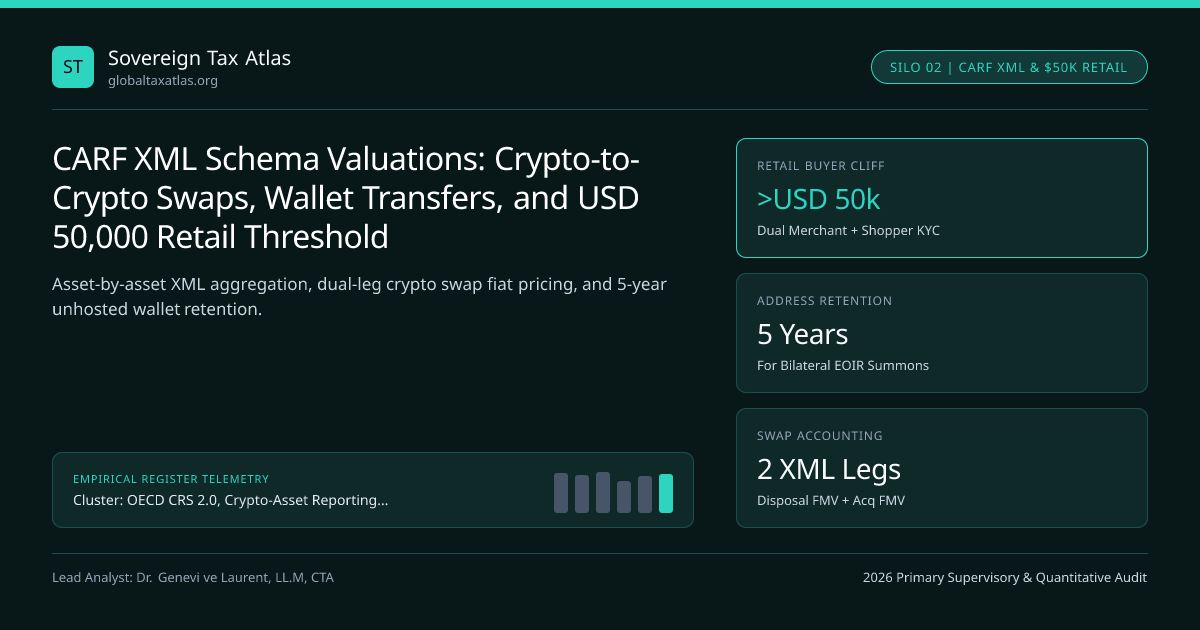
Once an exchange, prime broker, or swap router qualifies as an RCASP under CARF territorial nexus rules, Section II of the OECD Crypto-Asset Reporting Framework requires compiling an annual asset-by-asset aggregated CARF XML dossier for every Reportable User and Reportable Controlling Person. Framed within our OECD CRS 2.0, CARF, and FATCA compliance atlas, CARF does not transmit millions of individual blockchain transaction hashes; instead, it aggregates annual gross inflows and outflows by crypto-asset ticker, values every crypto-to-crypto swap in fiat currency at execution timestamp, and flags unhosted external wallet transfers so tax authorities can deploy blockchain analytics across the CRS 2.0, CARF & FATCA Exchange Rules cluster.
Three Core Transaction Buckets Aggregated Per Relevant Crypto-Asset#
For each specific Relevant Crypto-Asset (e.g., BTC, ETH, SOL, UNI—never netted across different tokens!), the OECD CARF XML Schema (v1.0) mandates reporting aggregate number of units, number of transactions, and gross fiat fair market value (net of transaction fees!) across three primary buckets:
- Crypto-to-Fiat Acquisitions and Disposals: Gross fiat paid for acquisitions and gross fiat proceeds received on disposals.
- Crypto-to-Crypto Exchange Transactions: Swapping 10 ETH into 185 SOL requires two simultaneous XML entries—(a) a Disposal of 10 ETH valued in fiat at the exact execution timestamp, and (b) an Acquisition of 185 SOL valued in that same single fiat currency!
- Transfers (Inward and Outward): Subdivided into Reportable Retail Payment Transactions (>USD 50,000), internal transfers, airdrops/staking/hard-fork inflows, transfers to/from other known RCASPs, and Transfers to/from External Wallet Addresses not known to be associated with a VASP or Financial Institution!
Crucial Privacy Compromise: How Unhosted Wallet Addresses Are Reported#
One of the fiercest debates during OECD CARF drafting centered on whether exchanges must transmit raw public blockchain addresses (0x... or bc1q...) inside automatic annual XML broadcasts. Look at the exact two-step compromise codified in Section II(A)(3)(g) and Commentary:
- Inside the Annual Automatic CARF XML: The RCASP reports only the aggregate fiat market value, total units, and transaction count transferred out to (and in from) External Wallet Addresses not known via FATF Travel Rule protocols to belong to a regulated VASP or bank—without embedding the hexadecimal wallet strings inside the automatic XML broadcast!
- Mandatory Five-Year Retention for Exchange-on-Request (EOIR): However, the RCASP must record and retain every external wallet address associated with those transfers for at least five years, allowing the user's tax authority (seeing USD 1.4 million of "External Wallet Outflows" in the automatic CARF XML!) to issue a targeted bilateral Exchange-of-Information-on-Request query for the exact 0x addresses!
- AnnualXMLLine(Useru, Tokenk, Typem) = { Sum(Units), Count(Txs), Sum(FiatFMVatExecution_t) }
- Worked CARF XML Aggregation (CY 2026 UK-Resident Trader on Cayman Exchange [CIMA]; Reporting Currency USD):
- 1. Buys 20.0 BTC for USD 1,600,000 fiat (USD 1,600 fee) -> BTC Fiat Acq: {20.0 BTC, 1 tx, USD 1,598,400}
- 2. Swaps 5.0 BTC (Spot FMV USD 450,000, fee USD 450) into 150.0 ETH:
- BTC Crypto-Swap Disposal: {5.0 BTC, 1 tx, USD 449,550}
- ETH Crypto-Swap Acquisition: {150.0 ETH, 1 tx, USD 449,550}
- 3. Withdraws 15.0 BTC (Spot FMV USD 1,380,000) to cold Ledger hardware wallet (Non-VASP External Wallet):
- BTC Outbound External Transfer: {15.0 BTC, 1 tx, USD 1,380,000} + Retain bc1q... address for 5 years!
- 4. Spends 25.0 ETH (FMV USD 75,000 > USD 50,000!) via Merchant Checkout API to buy luxury watch:
- Merchant RCASP reports Buyer (as Retail Customer!) & Merchant on USD 75,000 Reportable Retail Payment!
The USD 50,000 Reportable Retail Payment Transaction Dual-Customer Rule#
Look closely at Item #4 in the worked calculation above! When a payment processor (like BitPay, Coinbase Commerce, or a luxury payment gateway) processes crypto checkouts for a merchant selling luxury cars, watches, real estate, or yachts, Section IV(D)(2) imposes a dual-customer rule whenever a single payment for goods or services exceeds USD 50,000:
- Below or equal to USD 50,000, the payment processor treats only the Merchant as its customer (sparing retail shoppers buying a USD 120 software subscription from submitting tax-residency self-certifications at checkout).
- Strictly above USD 50,000, the payment processor must treat BOTH the Merchant AND the Paying Consumer as Reportable Users—collecting a valid CARF self-certification and TIN from the retail buyer before settling the >USD 50,000 checkout!
Valuation Hierarchy for Illiquid Altcoins and NFTs#
What if a trader swaps two obscure governance tokens or a fractionalized collectible NFT (note: NFTs functioning purely as non-investment collectibles without payment/investment use are excluded, whereas traded marketplace NFTs on venues like Axie Infinity or Basc Collection require functional investment-use screening!) that lack a direct USD or EUR order book? CARF Commentary mandates a four-step valuation waterfall: (1) contemporaneous fiat pair on the RCASP's own venue; (2) bridge valuation through a major liquid crypto-asset (e.g., ETH or USDC) priced in fiat on the RCASP; (3) composite third-party market indices; and (4) the RCASP's own reasonable documented valuation methodology—aligned closely with EU DAC8 XML specifications and IRS Form 1099-DA broker rules.
CARF XML Transaction Bucket Reference Matrix#
| CARF XML Element | Inflow vs Outflow | Valuation Rule | External Wallet Flag? | Key Audit Trigger for Tax Authorities |
|---|---|---|---|---|
| Fiat-to-Crypto / Crypto-to-Fiat | Acquisition & Disposal | Actual fiat net of fees | N/A | Mismatch between bank wire & reported fiat buys |
| Crypto-to-Crypto Swaps | Dual (1 Disposal + 1 Acq) | Spot fiat FMV at trade second | N/A | Unreported taxable capital gains on token-to-token swaps! |
| Known VASP / FI Transfers | Inbound & Outbound Transfer | Spot fiat FMV at transfer time | VASP-Verified (Travel Rule) | Cross-matching inflows at Exchange B vs Exchange A |
| Unhosted External Transfers | Inbound & Outbound Transfer | Spot fiat FMV at transfer time | Non-VASP Flag + 5-yr Hex Log | Large unhosted outflows triggering EOIR address summons |
| Retail Payment (>USD 50,000) | Outbound Retail Transfer | Checkout fiat invoice value | Buyer + Merchant Reported | High-value luxury purchases funded from untaxed DeFi gains |
Frequently asked questions
Are non-fungible tokens (NFTs) reportable Relevant Crypto-Assets under OECD CARF?
NFTs are reportable if they can be used for payment or investment purposes in practice (including fractionalized art, gaming yield assets, or actively traded marketplace NFTs); closed-loop digital tickets or non-transferable badges that cannot serve investment or payment functions are excluded.
Does transferring Bitcoin from Coinbase to a personal Ledger wallet trigger an immediate tax under CARF?
Self-transfers between a user exchange account and their own unhosted Ledger wallet are generally not taxable realization events in most jurisdictions, but CARF still requires Coinbase to report the outbound external transfer value so tax authorities can track off-exchange holdings!
How are staking rewards, liquidity-pool yield, and token airdrops categorized in the CARF XML schema?
The CARF XML schema includes dedicated transfer sub-types distinguishing staking/mining rewards, airdrops, hard forks, and crypto lending/collateral transfers from ordinary market acquisitions, helping tax authorities separate ordinary income from capital basis.
Can a buyer split a USD 90,000 watch purchase into two USD 45,000 crypto payments to dodge the USD 50,000 rule?
No. CARF Commentary applies anti-fragmentation aggregation rules aligned with FATF AML standards requiring payment processors to link related or split installment payments for the same underlying retail purchase.
Publication record
- Published
- 14 November 2026
- Updated
- 15 November 2026
- Author
- Dr. Geneviève Laurent, LL.M, CTA
- Review
- Review not recorded
- Automated fact check
- Passed in the stored pipeline record
- Source URLs
- 3 recorded
AI assistance recorded: anthropic/claude-opus-4.6. This field does not establish human review or source verification.
Academic & Institutional Attribution
Cite This Research & Embed Live Data Card
Standard academic & institutional research paper citation format.
Dr. Geneviève Laurent, LL.M, CTA. (2026, November 15). CARF XML Schema Valuations: Crypto-to-Crypto Swaps, Wallet Transfers, and USD 50,000 Retail Threshold. Sovereign Tax Atlas. https://globaltaxatlas.org/entries/carf-xml-schema-crypto-swaps-wallet-transfers-retail-thresholdRegulatory Directory Cross-Reference
Referenced Institutions & Regulatory Registries
Top Regulated Institutions in This Coverage Slice
Referenced Supervisory Authorities
Related Crs 2 Carf Fatca Exchange Rules & Institutional Briefings
Explore Crs 2 Carf Fatca Exchange Rules Hub (20) →Crs 2 Carf Fatca Exchange Rules
OECD CRS 2.0, CARF Crypto Reporting, and US FATCA IGA Institutional Compliance AtlasCrs 2 Carf Fatca Exchange Rules
EU DAC8 Directive vs OECD CARF: Extraterritorial Single Member State Registration and PenaltiesCrs 2 Carf Fatca Exchange Rules
US FATCA Model 1 vs Model 2 Intergovernmental Agreements and IRC Section 1471 30% WithholdingCrs 2 Carf Fatca Exchange Rules
IRS FATCA Registration Portal: GIIN Issuance, Sponsored FFI Hierarchies, and RO CertificationsCrs 2 Carf Fatca Exchange Rules
IRS Form W-8BEN-E Chapter 4 Classification: Active NFFE, Passive NFFE, and Investment EntitiesCrs 2 Carf Fatca Exchange Rules
IRS Form W-8IMY Documentation: Qualified Intermediaries, Withholding Partnerships, and Rate PoolsCrs 2 Carf Fatca Exchange Rules
CRS Controlling Persons Look-Through: 25% AML Thresholds and Discretionary Trust ProtectorsCrs 2 Carf Fatca Exchange Rules
Cayman Islands DITC Portal Governance: CRS Compliance Forms, CIMA Fund Audits, and PenaltiesDouble Tax Treaty Withholding Lob
BEPS MLI Article 7 Principal Purpose Test (PPT): Defending Intermediate Holding Companies in AuditDouble Tax Treaty Withholding Lob
US Model Article 22 Limitation on Benefits (LOB): Publicly Traded, Base Erosion, and Active TradeDouble Tax Treaty Withholding Lob
Treaty Derivative Benefits Test: 95% Ownership by 7 or Fewer Equivalent Beneficiaries Post-BrexitDouble Tax Treaty Withholding Lob
EU FASTER Directive (2025/50): Digital eTRCs, Certified Intermediaries, and 50-Day Quick Refunds
Sovereign Tax Atlas Data, Benchmarks & Contributor Records
CC BY 4.0 Open Data
Open Institutional Datasets (CSV / JSON) →
Download desk-compiled quantitative series & schemas.
2026 Reference Matrix
2026 Institutional Benchmarks & Thresholds →
Statutory capital, clearing, margin & rate conventions.
Editorial Records
Authors & Review Records →
View named contributors where those records are available.
Complete Index
Master Research & Dossier Archive →
Browse all published briefings by topic pillar & date.