
Cross Border Fund Spv Tax Neutrality
US IRC Section 864(b)(2) Trading Safe Harbor vs Direct Lending Loan Origination ECI Risks
Why can a USD 20 billion Greenwich hedge fund trade stocks and derivatives all day for a Cayman fund at 0% US ECI tax, while originating five middle-market US loans triggers 44.7% tax? Compare IRC Section 864(b)(2), GLAM 2009-010, and YA Global.
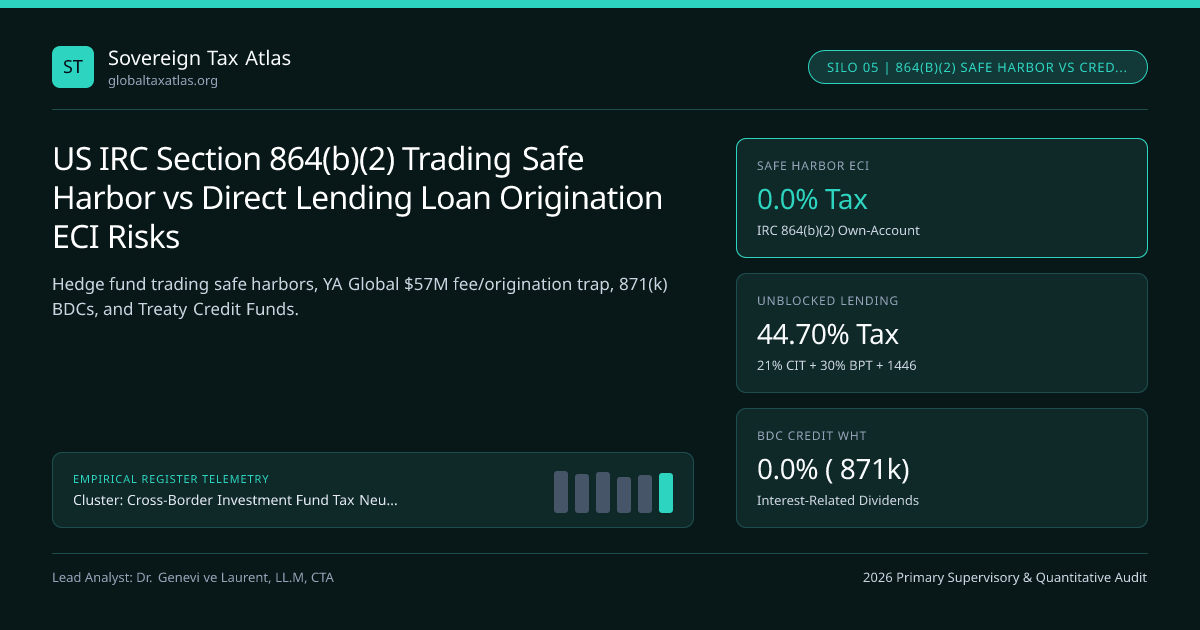
A New York hedge fund manager can execute 50,000 daily equity, bond, and swap trades for a Cayman Master Fund at 0.0% US ECI, yet originating five direct US loans triggers 44.7% US ECI + Branch Tax and forfeits 0% Portfolio Interest! Within our Cross-Border Fund Tax Neutrality & Blocker SPV Guide, understanding IRC Section 864(b)(2), IRS Chief Counsel Advice (GLAM 2009-010), and the landmark *Tax Court / Third Circuit YA Global Investments* decision (2023/2024)** is mandatory for every hedge and private credit GP across the Cross-Border Investment Fund Tax Neutrality, Blocker SPVs & Check-the-Box cluster.
How the IRC Section 864(b)(2) Stock & Commodities Trading Safe Harbor Works!#
Enacted in the Foreign Investors Tax Act of 1966 to keep global capital managed from Manhattan, IRC Section 864(b)(2)(A)(ii) and (B)(ii) state that "trade or business within the United States" DOES NOT INCLUDE:
- Trading in stocks, securities, or commodities (of a kind customarily dealt in on an organized commodity exchange) by a foreign person for the taxpayer's OWN ACCOUNT—even if executed directly by employees or a discretionary US investment manager maintaining its chief office in New York or Greenwich!
- Three Non-Negotiable Conditions to Stay Inside §864(b)(2):
- Must Be a "Trader" or "Investor"—NEVER a "Dealer"! Anyone regularly buying from or selling to customers in the ordinary course of business (making two-way markets, underwriting new equity/convertible debt offerings at a discount for distribution fees, or acting as a broker-dealer!) is disqualified immediately!
- Must Trade ONLY "Stocks, Securities, or Qualifying Commodities" (+ Proposed §864(b) Derivative Safe Harbor): Spot Bitcoin/Ethereum? Watch out—physical/spot non-traditional assets require careful commodity-exchange congruence analysis!
- NEVER Cross Into US "Loan Origination" or "Banking/Financing Business" (Treas. Reg. §1.864-4(c)(5))! Purchasing already-issued corporate bonds or syndicated loans on the secondary market is "trading in securities"—whereas negotiating loan terms with borrowers, structuring credit covenants, commitment-fee underwriting, and funding primary loans (>=5 loans/yr rule of thumb!) is an active lending business outside §864(b)(2)!
Landmark Warning: YA Global Investments, LP v. Commissioner (161 T.C. No. 11)!#
Every structured-credit, PIPE, convertible-note, and crypto-token fund manager MUST study **YA Global Investments, LP v. Commissioner (US Tax Court, Nov 2023)**:
- Facts: Offshore fund managed in New Jersey funded direct convertible debentures and standby equity lines, charging upfront commitment/structuring fees and 3%–10% market discounts.
- Three Holdings ($57.6M Liability!): (1) The US manager was a common-law agent imputing lending/underwriting directly to the offshore fund; (2) earning fees and dealer discounts exits §864(b)(2) trading (traders profit solely from market appreciation/yield!); and (3) skipping Form 8804 left the partnership indefinitely liable for unwithheld IRC §1446 tax!
Four Institutional Structures for Non-US LPs Investing in US Private Credit!#
Institutional private credit sponsors use three clean inbound models:
- Treaty Fund (Irish Sec. 110 / Lux / UK QAHC): Qualifies under Treaty Article 7 & LOB for 0.0% US ECI provided an independent non-US credit committee approves loans with zero US Dependent Agent PE!
- Season-and-Sell: An independent onshore Originator funds and holds loans unhedged for 60–90+ days (with zero forward take-out obligation) before the Offshore Fund independently buys secondary participations at FMV.
- US BDC / RIC (IRC §871(k)(1)) or Levered Blocker: Subchapter M BDCs distribute US loan interest as 0%-entity-tax, 0%-WHT Interest-Related Dividends to <10% foreign investors!
Quantitative US Direct-Lending Net Yield Comparison Across Four Credit Fund Wrappers#
- 1. Unblocked Cayman Credit Fund w/ NY Discretionary Origination (Fails §864(b)(2) -> ECI + Sec. 884 BPT = 44.70%):
- Net Yield = 9.00% * (1 - 0.4470) = 4.98% (Catastrophic -402 bps tax drag + US 1120-F filings!).
- 2. Levered Delaware C-Corp Credit Blocker (Deducts 30% EBITDA Shareholder Debt; ~23% Effective CIT on Remainder):
- Tax Drag = ~16.1% effective -> Net Yield = ~7.55% (Clean zero-ECI blocker, costs ~145 bps tax leakage).
- 3. Treaty Fund (Irish Section 110 / UK QAHC / Lux Treaty Co. w/ Zero US Agent PE; Art. 7 = 0% ECI + Art. 11 = 0% WHT):
- Tax Drag = ~2–5 bps local SPV margin -> Net Yield = ~8.95%!
- 4. US Regulated BDC (Subchapter M RIC — IRC §871(k)(1) Interest-Related Dividends to <10% Non-US Investors):
- 0.0% Entity Tax (90%+ payout) + 0.0% §871(k) Interest-Dividend WHT (check equity kickers/fees!) -> Net Yield = ~8.85%–9.00%!
Benchmarking US Hedge Trading vs Private Credit Structures (2026)#
Trading Safe Harbor & Credit Red-Line Compliance Matrix#
Under Treas. Reg. §1.1001-3, even secondary distressed-debt funds risk deemed new loan origination if they earn steering/backstop fees on a significant debt modification (>25 bps yield shift or maturity extension)! Credit compliance teams across CIMA, ESMA, and institutional trading firms like Arbitrage Prime Limited and Basefex enforce strict Tax Operating Guidelines:
| Transaction Type | Safe Inside §864(b)(2) Cayman Master? | Primary ECI / Withholding Trap | Institutional Operating Protocol |
|---|---|---|---|
| Secondary Syndicated Term Loan B | YES — if bought after primary syndication closes at market! | Never sign pre-closing commitment letters or earn upfront OID/ticking fees as a primary lender! | Wait >=48–72 hrs post-allocation from lead arranger bank; refund/adjust price vs fees! |
| Revolving Credit / Unfunded DDTL | NO — High Origination Risk! | Funding future draws + commitment fees = active banking! | Strip revolvers/unfunded DDTLs into an Onshore Feeder or ECI Blocker! |
| Distressed Debt Workout (§1.1001-3) | DANGER if frequent + steering fees! | Significant modification = deemed exchange for a new originated loan! | Limit restructuring frequency; decline work/backstop fees or drop into Workout Blocker! |
| Direct Unitranche / Mezzanine Lending | NO (44.7% ECI + loss of Portfolio Interest!) | YA Global + GLAM 2009-010 | Use US BDC (§871(k)), Treaty Fund (Zero US PE), Season-and-Sell, or Levered Blocker! |
Frequently asked questions
How does a US Business Development Company (BDC) pay 0% corporate tax AND 0% withholding tax to foreign private-credit investors?
A BDC elects Regulated Investment Company (RIC) status under Subchapter M (paying 0% corporate tax by distributing >=90% of income), and under IRC Section 871(k)(1) (made permanent in 2015), "Interest-Related Dividends" traced to US-source portfolio loan interest are exempt from 30% US dividend withholding for foreign shareholders holding <10% of the borrowers!
Why must an Irish or Luxembourg "Treaty Credit Fund" never allow its New York sub-advisor to approve or sign loan term sheets?
Under Article 5 and Article 7 of the US–Ireland and US–Luxembourg Tax Treaties, business profits from US lending are 0%-taxed ONLY if the foreign fund has NO US Permanent Establishment! If a New York advisor habitually negotiates final terms or exercises binding credit authority, it creates a Dependent Agent PE in New York—restoring full US ECI + Branch Tax!
What makes a "Season and Sell" private credit program survive an IRS substance-over-form audit?
Five strict guardrails: (1) Onshore Originator has independent capital and unrelated investors; (2) zero pre-arranged legally or economically binding forward take-out obligation; (3) Onshore Originator holds 100% credit/market risk during a 60–90+ day seasoning period; (4) Offshore Fund independently reviews and prices secondary purchases at then-current FMV; and (5) Offshore Fund never contacts borrowers pre-close!
Why did the statute of limitations NEVER expire against the fund in YA Global?
Because an offshore partnership engaged in a US trade or business with foreign partners must file IRS Form 8804 (Annual Return for Partnership Withholding Tax under Section 1446)—filing only Form 1065 does NOT start the 3-year statute of limitations on unfiled Form 8804 withholding liabilities!
Publication record
- Published
- 13 November 2026
- Updated
- 14 November 2026
- Author
- Dr. Geneviève Laurent, LL.M, CTA
- Review
- Review not recorded
- Automated fact check
- Passed in the stored pipeline record
- Source URLs
- 3 recorded
AI assistance recorded: anthropic/claude-opus-4.6. This field does not establish human review or source verification.
Academic & Institutional Attribution
Cite This Research & Embed Live Data Card
Standard academic & institutional research paper citation format.
Dr. Geneviève Laurent, LL.M, CTA. (2026, November 14). US IRC Section 864(b)(2) Trading Safe Harbor vs Direct Lending Loan Origination ECI Risks. Sovereign Tax Atlas. https://globaltaxatlas.org/entries/us-irc-section-864b2-trading-safe-harbor-loan-origination-eciRegulatory Directory Cross-Reference
Referenced Institutions & Regulatory Registries
Top Regulated Institutions in This Coverage Slice
Related Cross Border Fund Spv Tax Neutrality & Institutional Briefings
Explore Cross Border Fund Spv Tax Neutrality Hub (20) →Cross Border Fund Spv Tax Neutrality
Cross-Border Fund Tax Neutrality Guide: Blocker SPVs, Check-the-Box Elections, and Treaty PlatformsCross Border Fund Spv Tax Neutrality
US UBTI and IRC Section 514 Acquisition Indebtedness: Offshore Feeder Blockers and Section 514(c)(9)Cross Border Fund Spv Tax Neutrality
Singapore MAS Section 13O and Section 13U Tax Exemptions: VCC Umbrellas and 2025/2026 Tiered SpendingCross Border Fund Spv Tax Neutrality
Hong Kong Unified Fund Exemption (UFE) and HK$240M Family Office FIHV Zero-Tax RegimeCross Border Fund Spv Tax Neutrality
UK Qualifying Asset Holding Company (QAHC) Regime: Private Equity SPVs, 70% Category A Gate, and BuybacksCross Border Fund Spv Tax Neutrality
US PFIC Rules and IRS Form 8621: Section 1291 Excess Distributions vs QEF and Mark-to-Market ElectionsCross Border Fund Spv Tax Neutrality
Cross-Border Carried Interest Taxation: US IRC Section 1061, UK 32% / 2026 Income Tax Reform, and LuxembourgCross Border Fund Spv Tax Neutrality
US Branch Profits Tax (IRC Section 884): Dividend Equivalent Amounts, Treaties, and Complete TerminationRegulatory Compliance
Hedge-Fund Founder Fights 12-Year Sentence for Dividend Tax Scam - Bloomberg TaxTrade Policy
White House vows to press ahead with tariffs despite midterm backlash over rising pricesMarket Insights
Singapore wants a bigger slice of the global gold market. Is it too late to the party?Regulatory Compliance
SEC Announces Enforcement Annual Results for Fiscal Year 2026
Sovereign Tax Atlas Data, Benchmarks & Contributor Records
CC BY 4.0 Open Data
Open Institutional Datasets (CSV / JSON) →
Download desk-compiled quantitative series & schemas.
2026 Reference Matrix
2026 Institutional Benchmarks & Thresholds →
Statutory capital, clearing, margin & rate conventions.
Editorial Records
Authors & Review Records →
View named contributors where those records are available.
Complete Index
Master Research & Dossier Archive →
Browse all published briefings by topic pillar & date.