
Cross Border Fund Spv Tax Neutrality
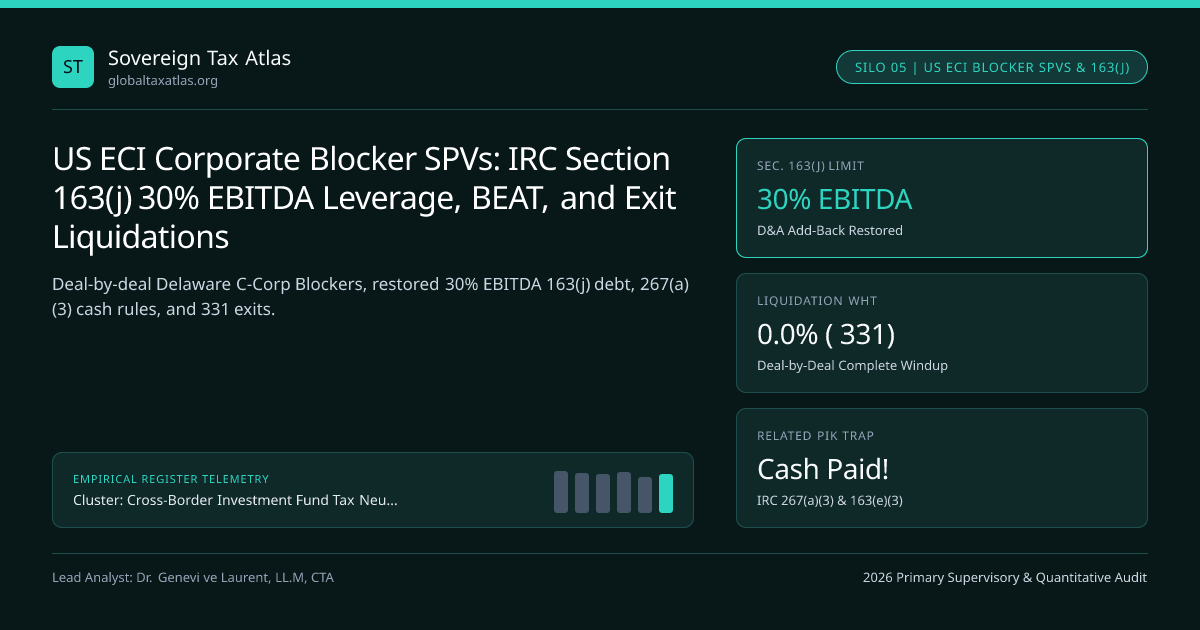
US ECI Corporate Blocker SPVs: IRC Section 163(j) 30% EBITDA Leverage, BEAT, and Exit Liquidations
Whenever a private equity fund acquires an operating US LLC pass-through business, non-US and sovereign LPs interpose a levered Delaware C-Corporation Blocker—using 30% EBITDA Section 163(j) shareholder debt and liquidating exits to cut effective US tax from 44.7% to ~14%.
Over 60% of US middle-market buyout targets operate as pass-through Delaware LLCs or S-Corporations so strategic buyers can secure a stepped-up amortizable asset basis (IRC §§743(b) / 338(h)(10)). Yet for a non-US pension, European fund-of-funds, or Sovereign Wealth Fund (IRC Sec. 892), owning a flow-through operating US LLC directly is toxic: under IRC Section 875(1), the US LLC's trade or business imputes directly up to every foreign partner, triggering 21% US Corporate Tax + 30% Section 884 Branch Profits Tax (= 44.70% combined tax!), mandatory Section 1446 quarterly withholding, and invasive US tax filings! Anchored in our Cross-Border Fund Tax Neutrality & Blocker SPV Guide, sponsors solve this cleanly via a Levered Delaware C-Corp ECI Blocker SPV across the Cross-Border Investment Fund Tax Neutrality, Blocker SPVs & Check-the-Box cluster.
Four Structural Pillars of an Institutional Levered US C-Corp Blocker#
Simply dropping an all-equity Delaware C-Corporation above a US OpCo LLC leaves you paying 21% federal + ~4%–6% state corporate tax on 100% of operating profits, PLUS 30% US dividend withholding if cash is distributed pre-exit! Institutional sponsors optimize every single layer:
- Capitalize With Arm's-Length Shareholder Debt Up to IRC §163(j) (30% of EBITDA Restored!) + §385:
- Instead of funding the Delaware Blocker 100% with equity, the Offshore Feeder funds ~65%–70% Equity + ~30%–35% Arm's-Length Shareholder Loan!
- With D&A add-backs restored under 2025 US tax law (OBBBA), IRC §163(j) permits deducting interest up to 30.0% of Tax EBITDA (carrying excess forward indefinitely), backed by a third-party IRC §385 / Ch. X Debt-Capacity Memo!
- Eliminate 30% Outbound Interest Withholding via Split Voting/Non-Voting Blocker Shares (Portfolio Interest 871(h)/881(c)) OR Treaty Feeders:
- Remember the 10% Shareholder Trap in IRC §871(h)(3): a Cayman Feeder owning 100% of a Blocker's voting stock CANNOT claim 0% Portfolio Interest on its loan!
- How Sponsors Solve It: (a) Multi-Blocker / Parallel Split (where no single Feeder/LP owns >=10% of voting power of the Blocker—watch constructive attribution under §318!), (b) Registered Debt Facility via Unrelated Credit Co-Investors, OR (c) Routing debt through a Treaty-Qualified Lender (0% UK/LU/IE/DE Article 11 clearing LOB + IRC §267A anti-hybrid checks!).
- Eliminate Interim 30% Dividend Withholding: During the 4–6 year hold period, repay Blocker Shareholder Loan principal + deductible interest rather than declaring ordinary Section 301 cash dividends!
- Execute a 0%-Tax Stock Sale ("Sell the Blocker!") or Complete §331 Liquidation at Exit:
- Preferred Exit #1 — Sell Blocker Stock: Buyer acquires the shares of the Delaware C-Corp Blocker directly from the Offshore Feeder -> 0.0% US Capital Gains Tax & 0.0% Withholding (provided the Blocker was NEVER a USRPHC real-estate-heavy company during the 5-year FIRPTA lookback!). (Note: Buyers often negotiate a slight 2%–5% purchase-price discount vs an asset step-up unless the Buyer is itself a stock buyer!)
- Preferred Exit #2 — Sell Underlying OpCo LLC Units, Pay 21% Inside Blocker, Then Liquidate Blocker Completely Under IRC §331: Liquidating distributions in complete winding-up of a non-USRPHC C-Corp are treated as payments in exchange for stock under IRC §331(a)—escaping 30% US dividend withholding completely (0.0% WHT!)!
Don't Miss the "Cash-Paid" Trap on Related Foreign Interest (IRC §§267(a)(3) & 163(e)(3))!#
Many private-equity deal models assume a Delaware Blocker can issue a non-cash-pay PIK (Paid-in-Kind) Shareholder Note to a related foreign feeder and deduct accrued unpaid PIK interest every year against 21% US corporate tax. STOP! Under IRC Section 267(a)(3) and Section 163(e)(3), a US corporation CANNOT deduct accrued interest or Original Issue Discount (OID) owed to a related foreign person (>50% common ownership) unless and until that interest is ACTUALLY PAID IN CASH (whereupon withholding tax, if any, attaches)! Always schedule annual cash interest sweeps on related-party blocker notes!
Quantitative Unblocked vs Unlevered Blocker vs Levered Blocker Waterfall#
- 1. Unblocked Foreign Partner (Direct in US OpCo LLC):
- Operating ECI + Sec. 884 BPT = 44.70% * USD 80M EBIT = USD 35.76M
- Exit Gain on US Trade/Business Partnership Interest (IRC §864(c)(8) + §1446(f)!) = 21% CIT (+ BPT if not complete termination) = USD 42.00M+
- Total Tax = ~USD 77.76M+ (PLUS Foreign LP must file US Corporate Tax Returns Form 1120-F!).
- 2. Unlevered All-Equity Delaware C-Corp Blocker (Selling OpCo LLC Units + §331 Liquidation; ~24% Fed+State CIT):
- Operating CIT = 24.0% * USD 80M = USD 19.20M; Exit CIT inside Blocker = 24.0% * USD 200M = USD 48.00M; §331 Liquidation WHT = USD 0!
- Total Tax = USD 67.20M (Zero foreign LP US tax returns!).
- 3. Levered Blocker (30% EBITDA Interest Shield = USD 30M Cash Interest @ 0% WHT + Buyer Buys Blocker Stock at 3% Basis Discount = USD 6M):
- Operating CIT = 24.0% * (USD 80M - USD 30M) = USD 12.00M; Exit Gain on Blocker Shares = USD 0 US Tax (+ USD 6M buyer discount)!
- Total Tax + Friction = USD 18.00M -> Saves USD 49.2M–59.7M of cash leakage!
Benchmarking US Blocker Designs Across Asset & LP Profiles#
US ECI Blocker Structuring & Exit Matrix#
Never hold multiple deals inside one shared Blocker: exiting Deal #1 while Deals #2–#5 remain blocks a §331 complete liquidation and triggers 30% IRC §301 dividend WHT! Buyout counsel across CIMA, JFSC, and deal advisors servicing 4Rexbox and Atm Capital enforce a dedicated Deal-by-Deal Blocker matrix:
| Structural Decision | Amateur Mistake | Institutional Best Practice | Statutory Authority |
|---|---|---|---|
| Number of Blockers | 1 Shared "Umbrella Blocker" holding 8 deals | 1 Dedicated Delaware C-Corp Blocker PER Portfolio Deal! | Enables clean 0%-WHT §331 Liquidation or Blocker Stock Sale on every single exit! |
| Shareholder Loan Coupon | Unpaid accrued PIK to >50% foreign feeder | Cash-pay interest inside 30% Tax EBITDA + §385 Debt Capacity study | IRC §163(j) + §267(a)(3) + §163(e)(3) |
| 0% Interest Withholding | 100%-owned Cayman feeder claims Portfolio Interest (FAILS!) | <10%-vote split feeders (check §318 attribution!) or 0%-Treaty Feeder (watch §267A!) | IRC §§871(h)(3) & 881(c)(3) |
| US State Income Tax | Ignoring state apportionment & §163(j) decoupling | Model state pass-through composite credits + state interest add-backs | DE/NY/CA corporate nexus rules |
| Sovereign LP Allocation | Putting SWF >50% in a commercial USRPHC blocker | Keep SWF <=49% non-controlling in Blocker (0% §892 Dividend WHT & 0% Stock Sale!) | SWF Parallel SPVs (IRC §892) |
Frequently asked questions
Why do US strategic buyers sometimes pay 2%–5% less when buying C-Corp Blocker stock instead of direct LLC units?
When a buyer purchases LLC units (with an IRC §754 election in place), the buyer gets an immediate IRC §743(b) fair-market-value step-up in underlying 15-year amortizable §197 goodwill—shielding the buyer future 21% taxes! Buying C-Corp Blocker stock carries over historical inside basis with zero step-up, so sellers and buyers typically split the NPV of the lost tax amortization in the negotiated stock price!
Does IRC Section 864(c)(8) (enacted in TCJA to overturn Grecian Magnesite) tax a foreign feeder when it sells shares of a Delaware C-Corp Blocker?
NO! IRC Section 864(c)(8) taxes a foreign partner ONLY when selling an interest in a PARTNERSHIP engaged in a US trade or business! Selling stock of a domestic C-Corporation Blocker (provided it was NOT a USRPHC real estate company during the 5-year FIRPTA window!) remains 100% exempt from US capital gains tax and Section 1446(f) withholding!
Can a US Tax-Exempt Endowment invest through the same Delaware C-Corp ECI Blocker as Non-US LPs?
Look closely before doing so! Unless the US OpCo LLC uses debt financing (which triggers 21% IRC §514 UBTI anyway) OR generates active operating UBTI, US Tax-Exempts already pay 21% UBTI directly—putting them inside a Delaware C-Corp Blocker adds state corporate taxes or double-tax friction if Deal-by-Deal blockers are not used. Most funds offer separate Offshore UBTI Blockers vs ECI Blockers!
What is the "Personal Holding Company" (PHC — IRC §541) or "Accumulated Earnings Tax" (AET — IRC §531) trap inside a C-Corp Blocker?
If 5 or fewer individuals indirectly own >50% of a C-Corp Blocker value AND >=60% of its gross income is passive (dividends/interest), IRC §541 slaps an extra 20% Personal Holding Company penalty tax on undistributed income—and IRC §531 imposes a 20% Accumulated Earnings Tax on corporations hoarding cash beyond reasonable business needs!
Publication record
- Published
- 13 November 2026
- Updated
- 14 November 2026
- Author
- Dr. Geneviève Laurent, LL.M, CTA
- Review
- Review not recorded
- Automated fact check
- Passed in the stored pipeline record
- Source URLs
- 3 recorded
AI assistance recorded: anthropic/claude-opus-4.6. This field does not establish human review or source verification.
Academic & Institutional Attribution
Cite This Research & Embed Live Data Card
Standard academic & institutional research paper citation format.
Dr. Geneviève Laurent, LL.M, CTA. (2026, November 14). US ECI Corporate Blocker SPVs: IRC Section 163(j) 30% EBITDA Leverage, BEAT, and Exit Liquidations. Sovereign Tax Atlas. https://globaltaxatlas.org/entries/us-eci-corporate-blocker-spv-section-163j-interest-leverageRegulatory Directory Cross-Reference
Referenced Institutions & Regulatory Registries
Top Regulated Institutions in This Coverage Slice
Related Cross Border Fund Spv Tax Neutrality & Institutional Briefings
Explore Cross Border Fund Spv Tax Neutrality Hub (20) →Cross Border Fund Spv Tax Neutrality
Cross-Border Fund Tax Neutrality Guide: Blocker SPVs, Check-the-Box Elections, and Treaty PlatformsCross Border Fund Spv Tax Neutrality
US FIRPTA (IRC Section 897): USRPHCs, QFPF Pensions, and Domestically Controlled REIT RulesCross Border Fund Spv Tax Neutrality
US IRC Section 864(b)(2) Trading Safe Harbor vs Direct Lending Loan Origination ECI RisksCross Border Fund Spv Tax Neutrality
US UBTI and IRC Section 514 Acquisition Indebtedness: Offshore Feeder Blockers and Section 514(c)(9)Cross Border Fund Spv Tax Neutrality
Singapore MAS Section 13O and Section 13U Tax Exemptions: VCC Umbrellas and 2025/2026 Tiered SpendingCross Border Fund Spv Tax Neutrality
Hong Kong Unified Fund Exemption (UFE) and HK$240M Family Office FIHV Zero-Tax RegimeCross Border Fund Spv Tax Neutrality
UK Qualifying Asset Holding Company (QAHC) Regime: Private Equity SPVs, 70% Category A Gate, and BuybacksCross Border Fund Spv Tax Neutrality
US PFIC Rules and IRS Form 8621: Section 1291 Excess Distributions vs QEF and Mark-to-Market ElectionsEurozone Economy
Eurozone faces fiscal tension over defence spending, energy prices - The Brussels TimesEuropean Debt Crisis
“From a Junk Bond Sell-Off to France’s Fiscal Troubles”: Turmoil Deepens in European Bond Markets, Raising Fears of Another Eurozone Debt Crisis - https://economy.ac/Regulatory Compliance
Hedge-Fund Founder Fights 12-Year Sentence for Dividend Tax Scam - Bloomberg TaxTrade Policy
White House vows to press ahead with tariffs despite midterm backlash over rising prices
Sovereign Tax Atlas Data, Benchmarks & Contributor Records
CC BY 4.0 Open Data
Open Institutional Datasets (CSV / JSON) →
Download desk-compiled quantitative series & schemas.
2026 Reference Matrix
2026 Institutional Benchmarks & Thresholds →
Statutory capital, clearing, margin & rate conventions.
Editorial Records
Authors & Review Records →
View named contributors where those records are available.
Complete Index
Master Research & Dossier Archive →
Browse all published briefings by topic pillar & date.