
Cross Border Fund Spv Tax Neutrality
US UBTI and IRC Section 514 Acquisition Indebtedness: Offshore Feeder Blockers and Section 514(c)(9)
Although exempt under IRC Section 501(c)(3) and Section 401(a), US endowments, charities, and corporate pensions pay 21% federal corporate tax on Unrelated Business Taxable Income (UBTI)—including prime-brokerage margin leverage under IRC Section 514.
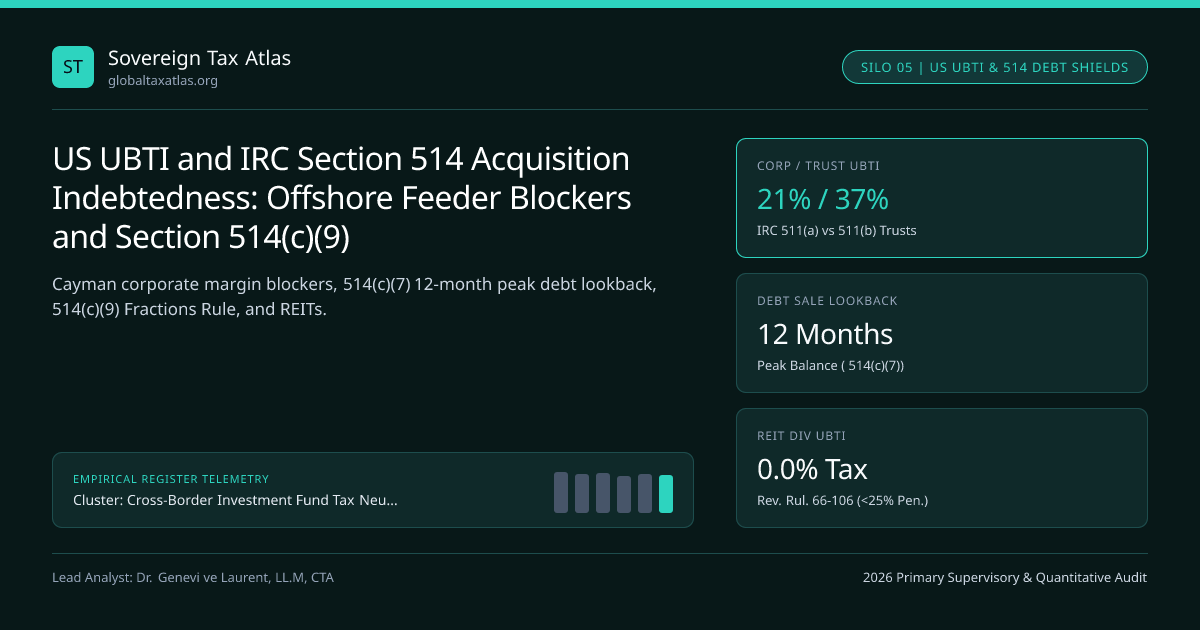
Why would Yale, Harvard, a major hospital foundation, or a Fortune 500 corporate pension plan (100% US tax-exempt under IRC Section 501(a)!) voluntarily invest its hedge fund allocation into an Offshore Cayman Islands Corporate Feeder regulated by CIMA instead of a domestic Delaware LP?! Two words: Acquisition Indebtedness! Under IRC Sections 511 through 514, US tax-exempt organizations owe 21.0% corporate federal income tax (or up to 37% trust rates for charitable trusts!) on Unrelated Business Taxable Income (UBTI)—and since 2018 (IRC Section 512(a)(6) "Siloing Rule"), losses from one unrelated partnership trade cannot even offset UBTI gains from another! Anchored in our Cross-Border Fund Tax Neutrality & Blocker SPV Guide, mastering Section 514 debt-financed UBTI, Offshore UBTI Blockers, and Section 514(c)(9) Fractions Rule real estate is essential across the Cross-Border Investment Fund Tax Neutrality, Blocker SPVs & Check-the-Box cluster.
Two Triggers of UBTI in Alternative Funds: Operating Pass-Throughs vs Debt-Financed Property!#
Ordinarily, IRC Section 512(b) excludes all passive dividends, interest, annuities, royalties, securities-lending payments, swaps (Treas. Reg. §1.512(b)-1(a)(1)), and capital gains from UBTI. That passive shield collapses via two fund-level triggers:
- Flow-Through Operating Business Income (IRC §512(c)): Investing through a Delaware PE partnership into a flow-through operating LLC (manufacturing, SaaS, healthcare, management fee waivers) passes active trade/business UBTI straight onto the charity's IRS Form 990-T!
- Debt-Financed Property / "Acquisition Indebtedness" (IRC Section 514 — The Hedge Fund Killer!): Even 100% passive S&P 500 dividends and long-term stock capital gains become taxable UBTI in exact proportion to the ratio of Average Acquisition Indebtedness / Average Adjusted Basis!
- What Counts as Acquisition Indebtedness in a Hedge Fund? Prime-brokerage margin borrowing and repo financing!
- Surprise Win — Short Sales & Notional Swaps Are NOT Debt!: Under Rev. Rul. 95-8, borrowing shares to execute a Short Sale (without borrowing cash!) does NOT create IRC §514 Acquisition Indebtedness! Similarly, entering an un-margined Total Return Swap or Futures Contract (notional leverage rather than borrowed cash!) generates 0% UBTI under Treas. Reg. §1.512(b)-1!
Why Cayman Corporate Blockers Beat Delaware C-Corp Blockers for Hedge Funds!#
Why block margin UBTI with a Cayman Exempted Company instead of a Delaware C-Corp? A Delaware C-Corp pays 21% CIT on all capital gains and interest, whereas a Cayman Feeder inside IRC §864(b)(2) pays 0% Cayman tax and 0% US capital-gain/interest tax (only 30% US dividend WHT)—and under IRC §512(b)(17), non-insurance CFC Subpart F/GILTI inclusions are 0% UBTI to a 501(c)(3)!
Read Carefully: Who Gets the IRC §514(c)(9) Real Estate Debt Exemption—And the "Fractions Rule"!#
When a private real estate fund buys an apartment tower with a 65% mortgage, does that mortgage trigger 21% Section 514 UBTI? It depends on WHICH type of US tax-exempt LP you are!
- ELIGIBLE "Qualified Organizations" (IRC §514(c)(9)(C)): (1) Qualified IRC §401(a) Pension/Retirement Trusts, (2) Educational Institutions (Universities/Colleges under §170(b)(1)(A)(ii)) and their affiliated support endowments, and (3) §501(c)(25) Title-Holding Companies!
- INELIGIBLE (Pay Full 21% UBTI Unless Blocked in a REIT or Blocker!): Private Foundations, Public Charities (Hospitals, Museums, Red Cross), and Individual IRAs! (Solution for Foundations & Hospitals: Invest via a Private REIT—under Rev. Rul. 66-106, ordinary and capital-gain dividends from a non-Pension-Held REIT are 0.0% UBTI* even when the REIT itself holds 70% mortgage debt!)*
- The "Fractions Rule" (IRC §514(c)(9)(E) & Treas. Reg. §1.514(c)-2): Whenever a Real Estate Partnership mixes Qualified Organizations (Pensions/Universities) with Taxable Partners (including the GP Carry!), §514(c)(9) shields the mortgage ONLY IF no Qualified Organization's share of overall partnership INCOME in any year can EXCEED its smallest share of overall partnership LOSS for any year (preventing shifting extra tax losses to taxable partners while shifting income to pensions!).
Quantitative Margin-Levered Hedge Fund UBTI vs Cayman Feeder Math#
- [Crucial Stock Sale Rule (§514(b)(1) / §514(c)(7)): For Gain on Sale, "Average Acquisition Indebtedness" = HIGHEST debt balance on ANY single day during the 12-month period ending on the sale date!]
- Worked USD 50M Endowment Allocation in Long/Short Equity Hedge Fund (USD 50M Equity + USD 50M Prime-Broker Margin = USD 100M Long Portfolio; Earns USD 18M Capital Gains + USD 2M US Dividends = USD 20M Gross Profit):
- 1. Held Directly in Unblocked Onshore Delaware LP:
- Debt/Basis Ratio = USD 50M Margin / USD 100M Basis = 50.0% Debt-Financed!
- Taxable UBTI = 50.0% * USD 20,000,000 (less 50% allocable margin interest/fees, say USD 2.5M) = USD 7,500,000 * 21% UBTI Tax = USD 1,575,000 Tax + Form 990-T!
- 2. Held via Offshore Cayman Corporate Feeder (0% Cayman Tax; 0% US Cap-Gain Tax; 30% WHT ONLY on USD 2M US Cash Dividends; 0% UBTI on Subpart F/GILTI!):
- Total Tax Leakage = 30.0% * USD 2,000,000 US Dividends = USD 600,000 (Zero Form 990-T UBTI!) -> Saves USD 975,000/yr (+195 bps on ROE)!
Benchmarking UBTI Blockers Across Alternative Asset Classes (2026)#
US Tax-Exempt Investor Onboarding & Blocker Matrix#
Under IRC §514(c)(7), paying off margin debt days before a stock sale fails because sale-gain UBTI uses the highest debt balance during the entire prior 12 months! Endowment CIOs and fund counsel across CIMA, JFSC, and institutional managers like Audacity Capital and Bancwesttrade apply this LP routing table:
| Tax-Exempt LP Type | Governing Code | Eligible for §514(c)(9) Real Estate? | Best Hedge / Credit Wrapper | Special Tax Watch-Item |
|---|---|---|---|---|
| Private University Endowment | §501(c)(3) / §170(b)(1)(A)(ii) | YES! (Qualified Org) | Cayman Corp Feeder / US BDC | IRC §4968 Endowment Net Investment Income Excise Tax! |
| State / Municipal Public Pension | IRC §115 / Sovereign Immunity | Often Exempt from UBTI under §115 (verify state counsel opinion!) | Onshore LP (saves 30% Cayman US div WHT!) | Many US State Pensions do NOT pay §511 UBTI at all—don't over-block them! |
| Corporate / Union ERISA Pension | IRC §401(a) Trust | YES! (Qualified Org) | Cayman Feeder (watch <25% ERISA cap!) | Track 37% Trust UBTI rate (§511(b)) if unblocked! |
| Private Foundation / Hospital | §501(c)(3) (Non-Educational) | NO! (Excluded from §514(c)(9)!) | Private REIT (Real Estate) + Cayman Corp (Hedge) | Foundations also face 1.39% §4940 Excise + §4943 Excess Business Holdings (<20%)! |
Frequently asked questions
Why do US State Public Pension Plans often refuse to invest in an Offshore Cayman UBTI Blocker Feeder?
Most US state and municipal retirement systems rely on IRC Section 115 and constitutional intergovernmental immunity to take the position that they are NOT subject to IRC Section 511 UBTI! Investing through the Onshore Delaware LP saves them the 30% US dividend withholding tax suffered by a Cayman Corporate Feeder.
When does a "Private REIT" fail to block UBTI for corporate pension plans under the "Pension-Held REIT" rule?
Under IRC Section 856(h)(3)(C)–(D), if a REIT relies on looking through domestic pension trusts to pass the 5/50 closely held test AND either (1) ONE pension trust holds >25% of the REIT OR (2) pension trusts holding >=10% each own >50% in aggregate, it becomes a "Pension-Held REIT"—forcing >=10% pensions to include a look-through share of REIT UBTI if >5% of REIT gross income is UBTI!
Do capital-call Subscription Credit Facilities trigger IRC Section 514 Acquisition Indebtedness for unblocked onshore tax-exempt LPs?
Fund tax counsel follow strict "short-term working-capital bridge" guidelines based on IRS Technical Advice Memoranda (e.g., TAM 9651001): if a subscription line bridges administrative capital calls for <=90–180 days and is repaid strictly from called LP capital (rather than permanent asset leverage), counsel generally opine no long-term Acquisition Indebtedness arises—whereas >365-day NAV or asset lines trigger full §514 UBTI!
Why must Private Foundations watch IRC Section 4943 "Excess Business Holdings" inside private equity partnerships?
Under IRC §4943, a Private Foundation (aggregated with its Disqualified Persons/founders!) faces punitive 10%–200% excise taxes if it owns >20% (or >35% with effective third-party control) of an active business enterprise—unless the fund generates >=95% passive income ("functionally passive investment pool" exception under §4943(d)(3)(B))!
Publication record
- Published
- 13 November 2026
- Updated
- 14 November 2026
- Author
- Dr. Geneviève Laurent, LL.M, CTA
- Review
- Review not recorded
- Automated fact check
- Passed in the stored pipeline record
- Source URLs
- 3 recorded
AI assistance recorded: anthropic/claude-opus-4.6. This field does not establish human review or source verification.
Academic & Institutional Attribution
Cite This Research & Embed Live Data Card
Standard academic & institutional research paper citation format.
Dr. Geneviève Laurent, LL.M, CTA. (2026, November 14). US UBTI and IRC Section 514 Acquisition Indebtedness: Offshore Feeder Blockers and Section 514(c)(9). Sovereign Tax Atlas. https://globaltaxatlas.org/entries/us-ubti-section-514-acquisition-debt-offshore-feeder-blockersRegulatory Directory Cross-Reference
Referenced Institutions & Regulatory Registries
Top Regulated Institutions in This Coverage Slice
Related Cross Border Fund Spv Tax Neutrality & Institutional Briefings
Explore Cross Border Fund Spv Tax Neutrality Hub (20) →Cross Border Fund Spv Tax Neutrality
Cross-Border Fund Tax Neutrality Guide: Blocker SPVs, Check-the-Box Elections, and Treaty PlatformsCross Border Fund Spv Tax Neutrality
Singapore MAS Section 13O and Section 13U Tax Exemptions: VCC Umbrellas and 2025/2026 Tiered SpendingCross Border Fund Spv Tax Neutrality
Hong Kong Unified Fund Exemption (UFE) and HK$240M Family Office FIHV Zero-Tax RegimeCross Border Fund Spv Tax Neutrality
UK Qualifying Asset Holding Company (QAHC) Regime: Private Equity SPVs, 70% Category A Gate, and BuybacksCross Border Fund Spv Tax Neutrality
US PFIC Rules and IRS Form 8621: Section 1291 Excess Distributions vs QEF and Mark-to-Market ElectionsCross Border Fund Spv Tax Neutrality
Cross-Border Carried Interest Taxation: US IRC Section 1061, UK 32% / 2026 Income Tax Reform, and LuxembourgCross Border Fund Spv Tax Neutrality
US Branch Profits Tax (IRC Section 884): Dividend Equivalent Amounts, Treaties, and Complete TerminationCross Border Fund Spv Tax Neutrality
Jersey Private Funds (JPFs), Guernsey PIFs, JPUTs, and UK NRCGT Schedule 5AAA Transparency ElectionsTrade Policy
White House vows to press ahead with tariffs despite midterm backlash over rising pricesMarket Insights
Singapore wants a bigger slice of the global gold market. Is it too late to the party?Regulatory Compliance
SEC Announces Enforcement Annual Results for Fiscal Year 2026Taxation Policy
California voters fail to pass proposed one-time tax on billionaires’ wealth
Sovereign Tax Atlas Data, Benchmarks & Contributor Records
CC BY 4.0 Open Data
Open Institutional Datasets (CSV / JSON) →
Download desk-compiled quantitative series & schemas.
2026 Reference Matrix
2026 Institutional Benchmarks & Thresholds →
Statutory capital, clearing, margin & rate conventions.
Editorial Records
Authors & Review Records →
View named contributors where those records are available.
Complete Index
Master Research & Dossier Archive →
Browse all published briefings by topic pillar & date.