
Cross Border Fund Spv Tax Neutrality
IRS Form 8832 Check-the-Box Elections: Foreign Default Rules, Per-Se Corporations, and 75-Day Windows
No single three-page form exerts greater leverage over international private equity, M&A, and CFC planning than IRS Form 8832—allowing eligible foreign entities to elect Corporate, Partnership, or Disregarded status inside a strict 75-day window.
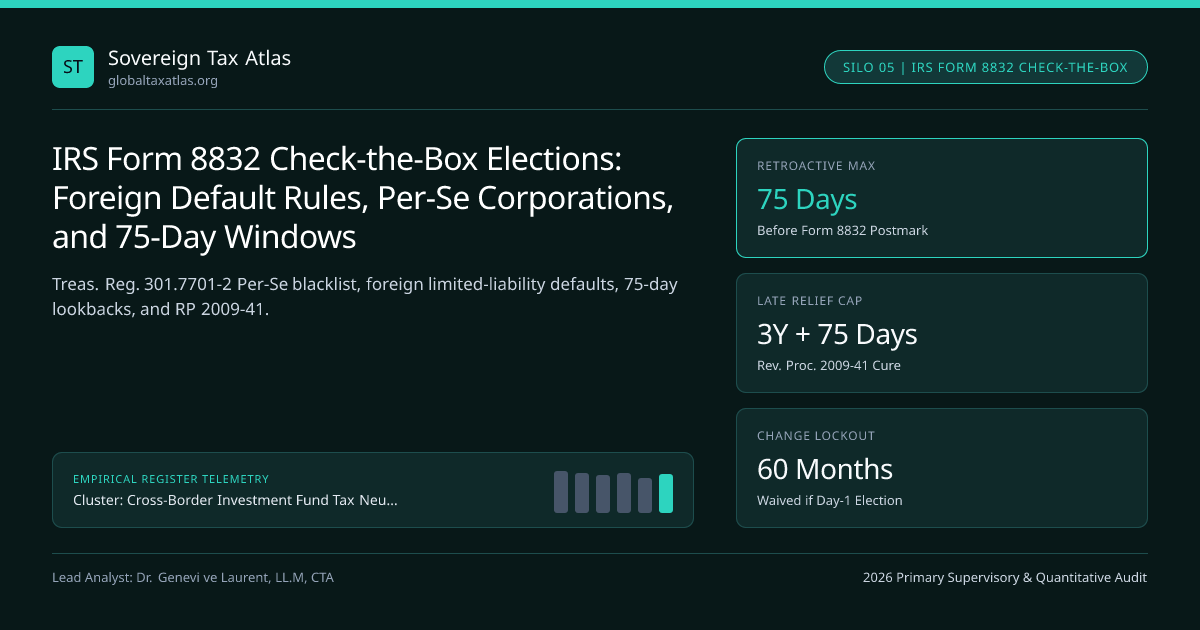
Ask any New York international M&A or fund tax partner which Treasury Regulation enables half of all cross-border acquisition stacks, PFIC Form 8621 shields, and Cayman fund feeders, and the answer is instant: Treas. Reg. §§301.7701-1 through 301.7701-3 — the "Check-the-Box" Entity Classification Regulations, executed on IRS Form 8832! Anchored in our Cross-Border Fund Tax Neutrality & Blocker SPV Guide, mastering Form 8832 requires checking three sequential gates—the Per-Se Corporation Blacklist, the Foreign Limited-Liability Default Trap, and the 60-Month Lockout / Deemed-Liquidation Tax Consequences—across the Cross-Border Investment Fund Tax Neutrality, Blocker SPVs & Check-the-Box cluster.
Gate 1 — Eligible Entity vs "Per-Se Corporation" Blacklist (Treas. Reg. §301.7701-2(b)(8))!#
Before promising an investor or deal team that you will "check the box open" on a foreign HoldCo, verify its exact statutory legal suffix against Treas. Reg. §301.7701-2(b)(8)! If a foreign entity is listed as a Per-Se Corporation, IRS Form 8832 is 100% PROHIBITED—it is locked permanently as a Corporation for US tax purposes (unless converted first under local corporate law into an eligible form!):
| Jurisdiction | LOCKED Per-Se Corporation (Cannot Check Open!) | ELIGIBLE Entity (CAN Check Partnership or Disregarded!) |
|---|---|---|
| Luxembourg | Société Anonyme (SA) | Sàrl (Société à responsabilité limitée), SCSp, SCS, SCA |
| Ireland | Public Limited Company (PLC) | DAC (Designated Activity Co.), LTD, ICAV (IE ICAV), ILP |
| United Kingdom | Public Limited Company (PLC) | Private Limited Company (Ltd) (UK QAHC Ltd), LLP, LP |
| Netherlands / Germany | Dutch NV (Naamloze Vennootschap); German AG (Aktiengesellschaft) | Dutch BV, CV; German GmbH, GmbH & Co. KG |
| Cayman / BVI / SG / HK | Singapore PLC; Hong Kong Public Limited Co. | Cayman Exempted Co., LLC, ELP; BVI BC; SG Pte. Ltd., VCC; HK Private Ltd |
Gate 2 — Why Foreign Entities Default the OPPOSITE Way From Domestic US LLCs!#
Never confuse Domestic US default rules with Foreign default rules—this mistake ruins dozens of funds every year:
- Domestic US Eligible Entity (e.g., Delaware LLC): Defaults to Flow-Through (Partnership if >=2 members; Disregarded Entity [DE] if 1 member)—only becoming a C-Corp if you affirmatively file Form 8832!
- Foreign Eligible Entity (Treas. Reg. §301.7701-3(b)(2)): Hinges 100% on whether ANY member has personal unlimited liability for the entity's debts under local law (and remember: if a thinly capitalized GP shell lacks substantial assets, IRS rules can scrutinize unlimited liability!):
- ALL members have limited liability (Lux Sàrl, UK Ltd, Cayman Exempted Co., Cayman LLC, Dutch BV, Irish ICAV): Defaults to a FOREIGN CORPORATION! To make it a Partnership (>=2 owners) or Disregarded Entity (1 owner), you MUST file IRS Form 8832!
- At least ONE member has genuine unlimited liability (traditional general/limited partnership with a substantive GP): Defaults to Partnership (>=2 members) or Disregarded Entity (1 member).
Gate 3 — Deadly Deemed Tax Transactions When Checking Mid-Life (Treas. Reg. §301.7701-3(g))!#
Filing an Initial Election effective on Formation Day 1 triggers ZERO deemed gain and does NOT start the 60-month lockout clock (allowing one free change anytime!). Conversely, changing classification on an existing operating entity triggers full statutory deemed liquidations or contributions:
- Corporation -> Disregarded Entity (1 Owner): Deemed Complete Liquidation of the foreign corporation into its owner immediately before the close of the preceding day! (Tax-free under IRC §332 + §367(b) E&P pickup* if owned >=80% by a US Corp; FULLY TAXABLE FMV §331 Liquidation triggering Subpart F / GILTI / PFIC gain if owned by a partnership or US individuals!)*
- Corporation -> Partnership (>=2 Owners): Deemed Liquidation of Corporation to shareholders (taxable FMV event!) followed immediately by §721 contribution to a new partnership!
- "Check-and-Sell" M&A Play: Checking a lower-tier CFC Disregarded pre-closing converts a 21%-Subpart-F Stock Sale into an Asset Sale tested under lower-taxed GILTI/NCTII (Dover Corp doctrine)!
Quantitative Timing & "Check-and-Sell" CFC Tax Comparison#
- [Tfile - 75 Calendar Days] <= ChosenEffectiveDate <= [Tfile + 12 Months]
- Missed 75-Day Cutoff? File Late Election with "FILED PURSUANT TO REV. PROC. 2009-41" across top within (T_effective + 3 Years + 75 Days)!
- Worked USD 100M Gain on CFC Holding Company ("TopCFC") Selling Wholly Owned Operating Subsidiary ("OpSub" — Zero Real Estate, Active Operating Tangible/Goodwill Assets):
- Path A — Unchecked Stock Sale (OpSub = Foreign Corp):
- USD 100M Gain on Stock = Passive Subpart F FPHCI (IRC §954(c)(1)(B)) -> Taxed immediately to US Parent at full 21.0% US CIT = USD 21,000,000!
- Path B — Pre-Closing Form 8832 "Check-and-Sell" (OpSub elects Disregarded Entity under §332 Liquidation into TopCFC prior to Buyer closing):
- For US tax purposes, TopCFC sells active trade/business assets -> Tested Income under IRC §951A NCTII @ 12.60% effective rate (minus 90% FTCs!) -> Saves up to USD 8.4M+!
Benchmarking Form 8832 Use Cases Across Funds & M&A#
Form 8832 Execution & Signature Checklist Matrix#
Fund operations directors and cross-border M&A teams working alongside CIMA, BVIFSC, and institutional administrators servicing Agile Global Limited and Archer Hunter audit five procedural traps before mailing Form 8832 to the IRS Ogden/Kansas City service center:
| Form 8832 Scenario | Who Must Sign Form 8832? | US Info Return Triggered | Deadly Trap to Avoid | Fix / Best Practice |
|---|---|---|---|---|
| Day-1 Protective Partnership Election (Cayman ELP / Lux SCSp / IE ICAV) | Authorized Officer / GP Manager (check local authority!) | Form 1065 (if US source/US partners threshold met) or K-1/K-3 | Waiting until Day 90 after admitting 50 LPs! | Mail Certified w/ Return Receipt inside 60 days of formation! |
| Retroactive Election (Up to 75 Days Back) | EVERY person who was an owner between Effective Date & Filing Date + Authorized Officer! | Form 8865 / Form 8858 | Missing signature of a redeemed Day-1 Incorporator share! | Elect effective prior to admitting passive LPs, or keep Incorporator signature! |
| Checking Foreign Subsidiary -> Disregarded Entity | Parent Officer | Annual IRS Form 8858 ($10,000+ failure penalties!) | IRC §1503(d) Dual Consolidated Loss (DCL) + Aug 2024 Prop. DCL Regs! | File Domestic Use Election + track Pillar Two / Foreign-Use DCL triggers! |
| Late Election (Missed 75-Day Cutoff) | All affected owners + Officer | Attach to timely US return (or file direct) | Exceeding 3 Years + 75 Days (forces $38,000+ IRS Private Letter Ruling!) | File immediately under Rev. Proc. 2009-41 with Reasonable Cause statement! |
Frequently asked questions
Why did the classic US-Dutch "CV/BV" and Luxembourg hybrid-debt structures stop working even though IRS Form 8832 still exists?
While the US still respects Form 8832 Disregarded Entity elections, EU ATAD 2 (effective 2020/2022 across Luxembourg, Ireland, and the Netherlands) and US IRC Section 267A (enacted in the 2017 TCJA) specifically disallow interest and royalty deductions whenever a payment exploits a Deduction/No-Inclusion (D/NI) hybrid entity mismatch!
Can a newly acquired portfolio company change its Check-the-Box status even if the seller changed it 18 months ago (inside the 60-month lockout)?
Two solutions exist: first, if the prior election was effective on the entity formation date, it does NOT trigger the 60-month lockout at all! Second, even if locked out, Treas. Reg. §301.7701-3(c)(1)(iv) empowers the IRS Commissioner to waive the 60-month restriction via Private Letter Ruling whenever >50% of ownership interests moved to new unrelated buyers!
What is IRS Form 8858 and why do multinationals get hit with automatic $10,000 penalties after checking foreign subsidiaries disregarded?
Every US person who is the tax owner of a Foreign Disregarded Entity (FDE) or Foreign Branch must attach Form 8858 (and Schedule M intercompany transactions) to their annual US return—missing Form 8858 triggers $10,000 penalties per entity PLUS progressive 10% Foreign Tax Credit reductions!
Does checking a foreign subsidiary Disregarded create "Dual Consolidated Loss" (DCL) traps under IRC Section 1503(d)?
Yes! If a Foreign Disregarded Entity incurs a net operating loss, IRC §1503(d) blocks using that loss on the US consolidated return UNLESS you file a strict "Domestic Use Election" certifying no foreign entity can ever use that loss under foreign tax consolidation or Pillar Two/hybrid sharing rules!
Publication record
- Published
- 13 November 2026
- Updated
- 14 November 2026
- Author
- Dr. Geneviève Laurent, LL.M, CTA
- Review
- Review not recorded
- Automated fact check
- Passed in the stored pipeline record
- Source URLs
- 4 recorded
AI assistance recorded: anthropic/claude-opus-4.6. This field does not establish human review or source verification.
Academic & Institutional Attribution
Cite This Research & Embed Live Data Card
Standard academic & institutional research paper citation format.
Dr. Geneviève Laurent, LL.M, CTA. (2026, November 14). IRS Form 8832 Check-the-Box Elections: Foreign Default Rules, Per-Se Corporations, and 75-Day Windows. Sovereign Tax Atlas. https://globaltaxatlas.org/entries/irs-form-8832-check-the-box-elections-per-se-corporationsRegulatory Directory Cross-Reference
Referenced Institutions & Regulatory Registries
Top Regulated Institutions in This Coverage Slice
Related Cross Border Fund Spv Tax Neutrality & Institutional Briefings
Explore Cross Border Fund Spv Tax Neutrality Hub (20) →Cross Border Fund Spv Tax Neutrality
Cross-Border Fund Tax Neutrality Guide: Blocker SPVs, Check-the-Box Elections, and Treaty PlatformsCross Border Fund Spv Tax Neutrality
US ECI Corporate Blocker SPVs: IRC Section 163(j) 30% EBITDA Leverage, BEAT, and Exit LiquidationsCross Border Fund Spv Tax Neutrality
US FIRPTA (IRC Section 897): USRPHCs, QFPF Pensions, and Domestically Controlled REIT RulesCross Border Fund Spv Tax Neutrality
US IRC Section 864(b)(2) Trading Safe Harbor vs Direct Lending Loan Origination ECI RisksCross Border Fund Spv Tax Neutrality
US UBTI and IRC Section 514 Acquisition Indebtedness: Offshore Feeder Blockers and Section 514(c)(9)Cross Border Fund Spv Tax Neutrality
Singapore MAS Section 13O and Section 13U Tax Exemptions: VCC Umbrellas and 2025/2026 Tiered SpendingCross Border Fund Spv Tax Neutrality
Hong Kong Unified Fund Exemption (UFE) and HK$240M Family Office FIHV Zero-Tax RegimeCross Border Fund Spv Tax Neutrality
UK Qualifying Asset Holding Company (QAHC) Regime: Private Equity SPVs, 70% Category A Gate, and BuybacksEarnings Reports
Wolverine Q3 2026 slides: tariff refunds boost beat, guidance raisedEurozone Economy
Eurozone faces fiscal tension over defence spending, energy prices - The Brussels TimesEuropean Debt Crisis
“From a Junk Bond Sell-Off to France’s Fiscal Troubles”: Turmoil Deepens in European Bond Markets, Raising Fears of Another Eurozone Debt Crisis - https://economy.ac/Regulatory Compliance
Hedge-Fund Founder Fights 12-Year Sentence for Dividend Tax Scam - Bloomberg Tax
Sovereign Tax Atlas Data, Benchmarks & Contributor Records
CC BY 4.0 Open Data
Open Institutional Datasets (CSV / JSON) →
Download desk-compiled quantitative series & schemas.
2026 Reference Matrix
2026 Institutional Benchmarks & Thresholds →
Statutory capital, clearing, margin & rate conventions.
Editorial Records
Authors & Review Records →
View named contributors where those records are available.
Complete Index
Master Research & Dossier Archive →
Browse all published briefings by topic pillar & date.