
Cross Border Fund Spv Tax Neutrality
Cayman Exempted Limited Partnership (ELP) Master-Feeder Architecture: Tax Undertakings and CIMA Rules
Housing over 65% of global institutional hedge fund and North American offshore private equity capital, the Cayman Islands Exempted Limited Partnership (ELP) pairs statutory legal non-personality with 50-year zero-tax undertakings.
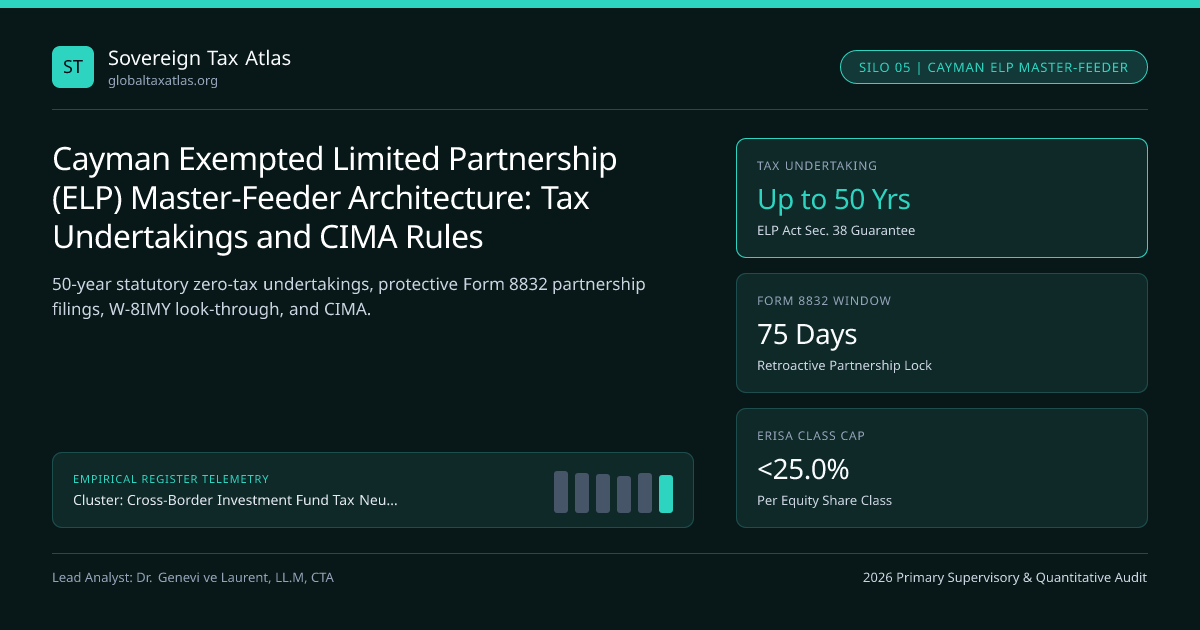
More than two-thirds of global alternative hedge fund assets and offshore North American buyout feeders flow through the Cayman Islands Exempted Limited Partnership (ELP) under the Exempted Limited Partnership Act (Revised) and supervision of the Cayman Islands Monetary Authority (CIMA). Within our Cross-Border Fund Tax Neutrality & Blocker SPV Guide, the Cayman ELP succeeds not through secrecy—Cayman executes full OECD CRS 2.0, CARF, and US FATCA Model 1B reporting—but through pure statutory tax transparency, zero entity-level leakage, and frictionless US Subchapter K alignment across the Cross-Border Investment Fund Tax Neutrality, Blocker SPVs & Check-the-Box cluster.
Statutory Mechanics of the Cayman ELP: Why Legal Non-Personality Matters!#
Under Section 4 and Section 9 of the Cayman ELP Act, a Cayman ELP does NOT possess separate legal personality distinct from its partners:
- General Partner (GP) Legal Title: All partnership assets, contracts, ISDA master agreements, and prime-brokerage accounts are held legally by (or on statutory trust for the partnership through) at least one qualifying General Partner (typically a Cayman Exempted Company, Delaware LLC registered as a foreign company in Cayman, or another Cayman ELP), while Limited Partners (LPs) enjoy ironclad statutory limited liability provided they do not take part in the conduct of the business with third parties (with broad statutory safe harbors in Section 20 for LP Advisory Committee [LPAC] votes!).
- Default US Tax Classification: Because LPs enjoy limited liability unless the GP personally assumes unlimited liability, watch Treas. Reg. §301.7701-3(b)(2): if the GP is a limited-liability shell company lacking substantial assets, a Cayman ELP where all members effectively have limited liability defaults to a Foreign Association Taxable as a Corporation for US tax purposes unless it files a protective IRS Form 8832 Check-the-Box Partnership Election within 75 days of formation!
- 50-Year Tax Undertaking Certificate: Under Section 38 of the ELP Act (and Section 6 of the Tax Concessions Act for Cayman Exempted Companies), the Cayman Cabinet/Financial Secretary issues a binding statutory undertaking up to 50 years (20–30 years for Exempted Companies) guaranteeing that if Cayman ever enacts income, profits, or capital gains taxes, they shall not apply to the partnership or its partners' interests!
Classic Master-Feeder vs "Mini-Master" (Private Credit & Hedge) Architectures#
Why do multi-strategy hedge funds build a Three-Entity Master-Feeder while credit sponsors often choose a Mini-Master?
- Classic Hedge Fund Master-Feeder:
- Onshore Feeder (Delaware LP): Holds US high-net-worth individuals and taxable family offices (requires Schedule K-1 flow-through of 60/40 Section 1256 futures gains and qualified dividends, avoiding PFIC Form 8621 disasters).
- Offshore Feeder (Cayman Exempted Company — Per-Se or Elected Corp): Holds Non-US investors (no US K-1s!) AND US Tax-Exempt Endowments/Foundations (blocking 21% IRC Section 514 margin-debt UBTI while tracking the <25% ERISA Benefit Plan Investor threshold per equity class!).
- Cayman Master Fund (Cayman ELP — Form 8832 Partnership): Executes 100% of trades under the IRC Section 864(b)(2) Trading Safe Harbor, eliminating trade-ticket splitting!
- Closed-End Private Credit "Mini-Master": When a credit fund originates US loans (generating ECI!), putting US taxable LPs below a corporate blocker wastes 21% US corporate tax on LPs who already file US returns! Instead, an Offshore Corporate Feeder ("Mini-Master") sits side-by-side with or above an Onshore Master Partnership—blocking ECI/UBTI strictly for Foreign and US Tax-Exempt LPs while leaving US Taxable LPs unblocked!
Quantitative W-8IMY Withholding & Tax-Neutrality Cash-Flow Math#
- WithholdingOnUSD10MUSTechDividends =
- (USTaxableDelawareFeederShare_40% * 0.0% WHT [W-9])
- + (CaymanCorporateFeederShare60% * 30.0% WHT [W-8BEN-E — No US-Cayman Treaty!])
- = USD 0 + USD 1,800,000 = USD 1,800,000 Withheld Specifically Against Offshore Feeder Capital Account!
- Key Optimization: If Non-US LPs are 0%-Treaty Pensions (UK/NL/CA/JP), admitting them via a Transparent Cayman ELP Feeder (W-8IMY + underlying LP W-8BEN-Es) instead of an Opaque Cayman Corporate Feeder slashes their US Dividend WHT from 30.0% to 0.0%!
Benchmarking Cayman Fund Vehicles Under CIMA & Global Tax Rules#
Cayman Master-Feeder Compliance & Tax Election Matrix#
Fund counsel and Cayman administrators working across CIMA, BVIFSC, and prime brokers/managers like Island Prime 54 Limited and Audacity Capital execute five Day-1 launch steps:
| Vehicle in Stack | Legal Form | IRS Form 8832 Action | US Withholding Form | Primary Regulatory / Tax Trap |
|---|---|---|---|---|
| Master Fund | Cayman ELP | File Form 8832 -> Partnership (within 75 days!) | Form W-8IMY + Withholding Statement | Missing 75-day Form 8832 risks default Corp taint! |
| Offshore UBTI Feeder | Cayman Exempted Co. | Default Corp (or protective Corp election) | Form W-8BEN-E (Sponsored/Reporting Model 1 FFI) | Never admit US Taxable individuals (PFIC trap)! |
| Treaty-Transparent Feeder | Cayman ELP | Partnership election | Form W-8IMY passing up LP W-8BEN-Es | Preserves 0%/15% US dividend treaty rates for EU/UK pensions! |
| General Partner (GP) | Cayman LLC / Co. | Partnership (if carry split) or Disregarded | W-8IMY / W-8BEN-E | Check Cayman Economic Substance (Fund Mgmt vs Pure GP exemption!) |
| Multi-Strategy SPC | Cayman SPC | Separate cell analysis (Proposed Prop. Reg. §301.7701-1(a)(5)!) | Separate W-8 per segregated portfolio | Never allow cross-portfolio collateralization to pierce ring-fence! |
Frequently asked questions
Why must a Cayman ELP file IRS Form 8832 to elect Partnership status if it is already called a "Limited Partnership"?
Under US Check-the-Box rules (Treas. Reg. §301.7701-3(b)(2)), a foreign entity defaults to a Corporation if ALL members have limited liability! When a Cayman ELP uses a thinly capitalized corporate GP shell with no substantial assets of its own, IRS rules can treat the GP liability as illusory—making a timely 75-day protective Form 8832 Partnership election mandatory practice!
Are Cayman Private Equity funds now regulated by CIMA just like open-ended hedge funds?
Yes—since the Cayman Private Funds Act (2020), closed-ended private equity, credit, real estate, and venture funds pooling >1 investor must register with CIMA before drawing capital for investment, appoint a CIMA-approved Cayman auditor, verify asset title/safekeeping, and file annual FAR returns.
Does OECD Pillar Two 15% Global Minimum Tax apply to a EUR 5 billion Cayman Master Fund?
Generally no—OECD GloBE Model Rules Article 1.5.1 explicitly designates "Investment Funds" (and Real Estate Investment Vehicles) that are Ultimate Parent Entities as Excluded Entities exempt from the 15% Top-Up Tax, preserving fund-level tax neutrality (though controlled operating portfolio companies below the fund remain testable!).
How does the 25% ERISA "Benefit Plan Investor" rule work inside a Cayman Corporate Feeder?
Under US ERISA Section 3(42), if US ERISA corporate/union pension plans + IRAs own >=25.0% of ANY class of equity in a hedge fund feeder (excluding governmental/church plans and GP affiliate shares from the denominator!), the entire fund becomes subject to strict ERISA fiduciary rules—so funds hard-cap ERISA LPs below 25% per share class!
Publication record
- Published
- 13 November 2026
- Updated
- 15 November 2026
- Author
- Dr. Geneviève Laurent, LL.M, CTA
- Review
- Review not recorded
- Automated fact check
- Passed in the stored pipeline record
- Source URLs
- 3 recorded
AI assistance recorded: anthropic/claude-opus-4.6. This field does not establish human review or source verification.
Academic & Institutional Attribution
Cite This Research & Embed Live Data Card
Standard academic & institutional research paper citation format.
Dr. Geneviève Laurent, LL.M, CTA. (2026, November 15). Cayman Exempted Limited Partnership (ELP) Master-Feeder Architecture: Tax Undertakings and CIMA Rules. Sovereign Tax Atlas. https://globaltaxatlas.org/entries/cayman-exempted-limited-partnership-master-feeder-fund-taxRegulatory Directory Cross-Reference
Referenced Institutions & Regulatory Registries
Mentioned Regulated Institutions
Related Cross Border Fund Spv Tax Neutrality & Institutional Briefings
Explore Cross Border Fund Spv Tax Neutrality Hub (20) →Cross Border Fund Spv Tax Neutrality
Cross-Border Fund Tax Neutrality Guide: Blocker SPVs, Check-the-Box Elections, and Treaty PlatformsCross Border Fund Spv Tax Neutrality
Luxembourg SCSp and RAIF Structuring: 0.01% Subscription Tax and ATAD 2 Reverse-Hybrid RulesCross Border Fund Spv Tax Neutrality
Irish ICAV QIAIFs and Section 110 SPVs: Profit-Participating Notes, 15% US ETF Treaty WHT, and Anti-HybridsCross Border Fund Spv Tax Neutrality
IRS Form 8832 Check-the-Box Elections: Foreign Default Rules, Per-Se Corporations, and 75-Day WindowsCross Border Fund Spv Tax Neutrality
US ECI Corporate Blocker SPVs: IRC Section 163(j) 30% EBITDA Leverage, BEAT, and Exit LiquidationsCross Border Fund Spv Tax Neutrality
US FIRPTA (IRC Section 897): USRPHCs, QFPF Pensions, and Domestically Controlled REIT RulesCross Border Fund Spv Tax Neutrality
US IRC Section 864(b)(2) Trading Safe Harbor vs Direct Lending Loan Origination ECI RisksCross Border Fund Spv Tax Neutrality
US UBTI and IRC Section 514 Acquisition Indebtedness: Offshore Feeder Blockers and Section 514(c)(9)Regulatory and Market Glossary
EU set to delay 10% tariff on electric cars from UK, FT reports - Euronext Markets: Real-time Stock Market Data | liveTrade Policy
Canada’s ambassador warns Trump tariffs are driving up costs, threatening U.S. investmentMarket Insights
Inside India newsletter: Trump's poll setback fuels hope for U.S.-India trade deal by year endEarnings Reports
Wolverine Q3 2026 slides: tariff refunds boost beat, guidance raised
Sovereign Tax Atlas Data, Benchmarks & Contributor Records
CC BY 4.0 Open Data
Open Institutional Datasets (CSV / JSON) →
Download desk-compiled quantitative series & schemas.
2026 Reference Matrix
2026 Institutional Benchmarks & Thresholds →
Statutory capital, clearing, margin & rate conventions.
Editorial Records
Authors & Review Records →
View named contributors where those records are available.
Complete Index
Master Research & Dossier Archive →
Browse all published briefings by topic pillar & date.