
Cross Border Fund Spv Tax Neutrality
US PFIC Rules and IRS Form 8621: Section 1291 Excess Distributions vs QEF and Mark-to-Market Elections
When a US citizen, green-card holder, or US family partnership invests in an offshore corporate fund or foreign ETF, IRC Sections 1291–1298 trigger Passive Foreign Investment Company (PFIC) taxation—reaching 50%–70%+ effective rates without a Year-1 QEF election.
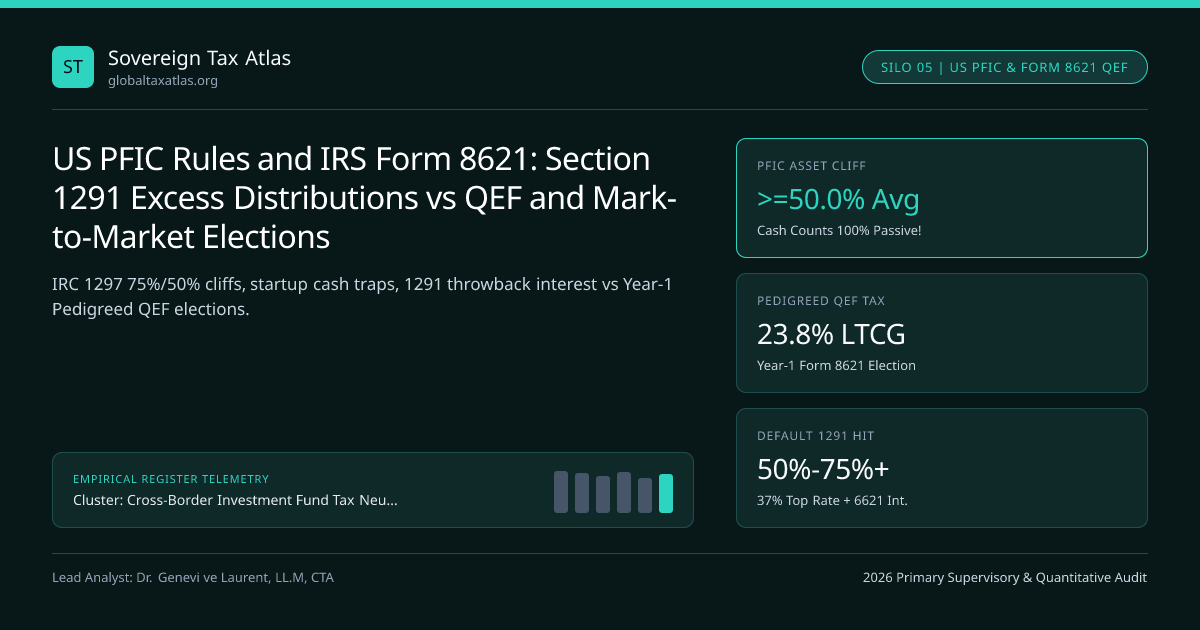
Every cross-border wealth advisor and investor-relations team must memorize one ironclad rule: NEVER admit a US taxable individual, US trust, or US family partnership into an un-checked Cayman Corporate Feeder, UCITS ETF (Irish ICAV UCITS / Lux SICAV), or foreign startup without modeling IRC Sections 1291–1298 — the Passive Foreign Investment Company (PFIC) regime! Unlike US CFC rules (which require >50% US control by >=10% US Shareholders), PFIC status has ZERO minimum US ownership threshold—owning 0.001% (USD 5,000) of a USD 5 billion foreign corporate fund triggers full annual IRS Form 8621 compliance! Within our Cross-Border Fund Tax Neutrality & Blocker SPV Guide, understanding PFIC asset/income cliffs, punitive Section 1291 Excess Distribution compounding, and Year-1 QEF Rescue Elections protects US LPs across the Cross-Border Investment Fund Tax Neutrality, Blocker SPVs & Check-the-Box cluster.
Two Mechanical PFIC Triggers (IRC §1297(a)) — Including the "Startup Cash Trap"!#
A foreign corporation (or any foreign entity classified as a corporation because it skipped IRS Form 8832!) is a PFIC for a taxable year if it meets EITHER test (applying a >=25% Subsidiary Look-Through Rule* under §1297(c), where owning >=25% of a subsidiary looks through to a pro-rata share of the subsidiary's active assets and revenue!*):
- 75% Passive Income Test: >=75.0% of gross income for the taxable year is passive income (dividends, interest, rents, royalties, capital gains, FX/commodities/crypto gains).
- 50% Passive Asset Test (Quarterly Average!): >=50.0% of average quarterly assets produce (or are held to produce, including working-capital CASH and Treasury bills!) passive income!
- VC Startup Cash Trap: Because bank cash is passive, a Series A foreign AI startup holding $25M of cash (>50% assets) becomes a PFIC unless it exits PFIC status in Years 2 & 3 (§1298(b)(2))—and under "Once a PFIC, Always a PFIC" (§1298(b)(1)), that taint persists forever unless purged!
Why Default IRC Section 1291 ("Excess Distribution") Math Can Exceed 65% Tax!#
If a US taxpayer sells shares of a PFIC (or receives a distribution exceeding 125% of the prior 3-year average distributions) without a Year-1 Pedigreed QEF or Mark-to-Market election in place, 100% of the sale gain suffers Section 1291:
- Zero Long-Term Capital Gain Rates: 100% of gain is taxed as ordinary/excess distribution!
- Pro-Rata Daily Throwback: Gain is allocated ratably across every single day of the investor's holding period.
- Automatic Maximum Statutory Tax Rate (37.0% + 3.8% NIIT!): Prior-year slices are taxed automatically at the HIGHEST statutory federal rate in effect for each prior year (37.0% / 39.6%)—even if the taxpayer had zero other income or $10M of NOLs in those years!
- Non-Deductible Daily Compounded IRS Underpayment Interest (§6621 — 7%–8%/yr recently!): Added on top of every prior year's throwback tax from that prior year's April 15th due date until exit—pushing total effective tax past 55%–75% on a 7-to-10-year hold (plus zero step-up in basis at death under §1291(e)!)!
How Institutional Funds Rescue US Taxable LPs: The "PFIC Annual Information Statement" (QEF — IRC §1295)!#
When a Cayman corporate feeder or European VC fund admits US taxable partners or founders, the fund's CPA issues an Annual PFIC Information Statement (signed under Treas. Reg. §1.1295-1(g)) reporting each US investor's daily pro-rata share of (a) Ordinary Earnings and (b) Net Capital Gain:
- By filing Form 8621 checking Box A ("Election to Treat the PFIC as a QEF") on the timely filed US tax return for the VERY FIRST YEAR of ownership ("Pedigreed QEF"), the US investor includes annual QEF net capital gains at 20% + 3.8% = 23.8% LTCG (increasing stock basis so exit distributions are tax-free!) and completely escapes Section 1291 throwback interest! (Retail European UCITS ETFs rarely issue US QEF Statements, forcing US expats into §1296 Mark-to-Market!)
Quantitative 7-Year USD 1,000,000 -> USD 3,100,000 Gain: Default §1291 vs Year-1 Pedigreed QEF!#
- (G / N) * (CurrentYr37%Ordinary + 3.8%NIIT)
- + Sum{t = 1..N-1} [ (G / N) * MaxStatutoryRateYrt(37%) * (1 + IRSSec6621InterestRater)^(N - t) ] + 3.8% * G
- Worked USD 2,100,000 Exit Gain After Exactly 7.0 Years (Zero Interim Cash Dividends; Underlying Gains = Long-Term Capital Gains; Avg IRS §6621 Rate = 7.0% Compounded):
- 1. Un-Elected Default PFIC (IRC §1291 Excess Distribution — USD 300,000/yr Throwback):
- Current Year 7 Slice ($300k @ 40.8%) = USD 122,400.
- Prior Years 1–6 Base Tax (6 * $300k * 37.0%) + 3.8% NIIT ($68.4k) = USD 666,000 + USD 68,400 = USD 734,400.
- Compounded §6621 Interest Charge on Yrs 1–6 Tax (~7.0% over 1..6 yrs) = ~USD 241,500!
- Total Default §1291 Tax + Interest = USD 1,098,300 (52.30% Effective Tax Rate — gets even worse to 68%+ over 10–12 yrs!)!
- 2. Timely Year-1 "Pedigreed QEF" Election (IRC §1295 — Gains Realized in Year 7 as Net Capital Gain):
- Taxed at 20.0% LTCG + 3.8% NIIT = 23.80% * USD 2,100,000 = USD 499,800 -> Saves USD 598,500 in hard cash!
Benchmarking US Investor Foreign Fund Solutions (2026)#
PFIC Form 8621 & Partnership QEF Filing Matrix#
Watch two procedural traps: (1) missing Form 8621 freezes the statute of limitations on the entire Form 1040 (IRC §6501(c)(8)); and (2) under Treas. Reg. §1.1295-1(d)(2), a domestic Delaware LP files one partnership-level QEF election, whereas in a foreign Cayman ELP each US partner files separately! Cross-border fund CPAs alongside CIMA, ESMA, and global wealth platforms servicing 1Inch Wallet and Astrovault follow this matrix:
| Investor / Vehicle Scenario | Who Files Form 8621 QEF Election? | Does Fund Issue PFIC Statement? | Action Required in Year 1 |
|---|---|---|---|
| US VC Fund (Delaware LP) -> Foreign Startup Corp | Delaware LP makes 1 partnership-level QEF election (§1.1295-1(d)(2)(i))! | Startup signs PFIC Information Letter in Series A Side Letter! | Always put Mandatory Annual PFIC Testing & QEF Statement Covenant in VC NVCA Side Letters! |
| Cayman ELP Fund -> Foreign Portfolio Corp | Each individual US Partner files their own Year-1 Form 8621 QEF (§1.1295-1(d)(2)(iii))! | Cayman GP distributes PFIC Statements with K-1s | Alert US LPs before April 15 / Oct 15—missing Year 1 creates an "Unpedigreed QEF"! |
| US Expat Buying Irish UCITS ETF | Individual US Taxpayer | NO! (European retail ETFs refuse QEF!) | Elect §1296 Mark-to-Market in Year 1 (or buy US ETFs via institutional advisor / direct stocks)! |
| Late Discovery in Year 3 ("Unpedigreed QEF") | US Taxpayer / Partnership | Yes (once discovered) | File QEF Election + Simultaneous §1291(d)(2)(A) Deemed-Sale Purge Election to stop future §1291 compounding! |
Frequently asked questions
Why does working-capital cash raised in a Series A venture round turn an active foreign AI or SaaS company into a PFIC?
Under IRS Notice 88-22 and proposed PFIC regulations, cash and short-term bank deposits are per-se PASSIVE assets! If a UK or Cayman startup has $4M of IP/operating assets and raises $20M of Series A cash (83% cash!), its quarterly average passive assets exceed 50%—making it a PFIC unless it exits PFIC status in BOTH Years 2 and 3 under the narrow §1298(b)(2) Start-Up Exception!
How do you fix a PFIC if you forgot to make the QEF election in Year 1 ("Unpedigreed QEF")?
Simply filing a QEF election in Year 3 WITHOUT a purge leaves the stock subject to BOTH QEF rules AND punitive §1291! Instead, file a QEF election paired with a simultaneous IRC §1291(d)(2)(A) "Deemed-Sale Purge Election" on Form 8621—paying §1291 tax on unrealized appreciation accrued through Day 1 of Year 3 so all post-Year-3 growth becomes a clean Pedigreed QEF!
Does the $25,000 ($50,000 Married Filing Jointly) Form 8621 filing exception exempt me from PFIC tax when I eventually sell?
NO! Treas. Reg. §1.1298-1(c)(2) only waives filing an informational Form 8621 in years where aggregate PFIC value is <=$25k/$50k AND you have ZERO excess distributions or sale gains AND no QEF/MTM election is in place—the instant you sell at a profit, full punitive Section 1291 throwback tax + interest hits!
If a US investor owns >=10% of a foreign startup that is ALSO >50% US-owned (a Controlled Foreign Corporation), do both CFC and PFIC rules apply?
Under the IRC Section 1297(d) CFC/PFIC Overlap Rule, a >=10% US Shareholder (by vote or value) who is subject to Subpart F / GILTI CFC rules is EXEMPT from the PFIC rules during their qualified CFC holding period (provided they were never tainted by PFIC status BEFORE the company became a CFC without purging)!
Publication record
- Published
- 13 November 2026
- Updated
- 14 November 2026
- Author
- Dr. Geneviève Laurent, LL.M, CTA
- Review
- Review not recorded
- Automated fact check
- Passed in the stored pipeline record
- Source URLs
- 3 recorded
AI assistance recorded: anthropic/claude-opus-4.6. This field does not establish human review or source verification.
Academic & Institutional Attribution
Cite This Research & Embed Live Data Card
Standard academic & institutional research paper citation format.
Dr. Geneviève Laurent, LL.M, CTA. (2026, November 14). US PFIC Rules and IRS Form 8621: Section 1291 Excess Distributions vs QEF and Mark-to-Market Elections. Sovereign Tax Atlas. https://globaltaxatlas.org/entries/us-pfic-form-8621-excess-distributions-vs-qef-fund-electionsRegulatory Directory Cross-Reference
Referenced Institutions & Regulatory Registries
Top Regulated Institutions in This Coverage Slice
Related Cross Border Fund Spv Tax Neutrality & Institutional Briefings
Explore Cross Border Fund Spv Tax Neutrality Hub (20) →Cross Border Fund Spv Tax Neutrality
Cross-Border Fund Tax Neutrality Guide: Blocker SPVs, Check-the-Box Elections, and Treaty PlatformsCross Border Fund Spv Tax Neutrality
Cross-Border Carried Interest Taxation: US IRC Section 1061, UK 32% / 2026 Income Tax Reform, and LuxembourgCross Border Fund Spv Tax Neutrality
US Branch Profits Tax (IRC Section 884): Dividend Equivalent Amounts, Treaties, and Complete TerminationCross Border Fund Spv Tax Neutrality
Jersey Private Funds (JPFs), Guernsey PIFs, JPUTs, and UK NRCGT Schedule 5AAA Transparency ElectionsCross Border Fund Spv Tax Neutrality
Subscription Credit Lines and NAV Facilities: Withholding Tax, UBTI Bridges, and EU ATAD 2 Anti-Hybrid RulesCross Border Fund Spv Tax Neutrality
GP-Led Continuation Funds and LP Secondaries: IRC Section 1446(f) 10% Gross Withholding and RolloversCross Border Fund Spv Tax Neutrality
Sovereign Wealth Fund Parallel and Co-Investment SPVs: Shielding IRC Section 892 Against Commercial TaintCross Border Fund Spv Tax Neutrality
UAE DIFC and ADGM Qualifying Investment Funds: 0% UAE Corporate Tax and Cabinet Decision No. 34 of 2025Regulatory and Market Glossary
Tech’s biggest names sunk a tax on billionaires’ wealth with $425m and a familiar playbookEnergy Policy
Thousands of 'off-grid' homes eligible for £250 to help with heating billsTax Policy
Californians reject wealth tax for billionairesTax Policy
Billionaire tax measure on California ballot defeated
Sovereign Tax Atlas Data, Benchmarks & Contributor Records
CC BY 4.0 Open Data
Open Institutional Datasets (CSV / JSON) →
Download desk-compiled quantitative series & schemas.
2026 Reference Matrix
2026 Institutional Benchmarks & Thresholds →
Statutory capital, clearing, margin & rate conventions.
Editorial Records
Authors & Review Records →
View named contributors where those records are available.
Complete Index
Master Research & Dossier Archive →
Browse all published briefings by topic pillar & date.